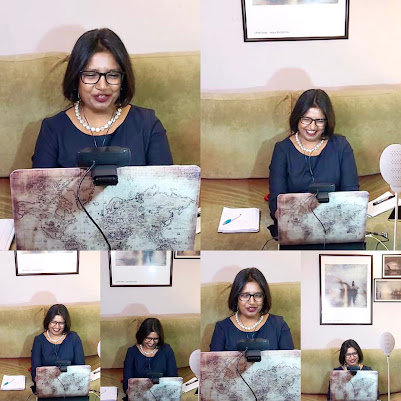
Recently, I did a Q&A with the SpaceWatch Global on the US Space Resources Executive Order.
On 6 April 2020, US President Donald J. Trump signed an Executive Order (EO) on Encouraging International Support for the Recovery and Use of Space Resources. This order addresses US policy regarding the recovery and use of resources in outer space, including the Moon and other celestial bodies. Over the next few weeks, SpaceWatch.Global will publish a range of perspectives supporting and opposing the EO from experts around the world. Today’s two expert perspectives come from Rajeswari Rajagopalan of India (below) and Professor Guoyu Wang of China.
For the full Q&A, click here.
In your opinion, what is the underlying strategic and economic rationale for President Trump’s Executive Order?
The possible underlying economic and strategic rationale is to gain the first mover advantage. While the US and other western space players talk about space mining and resource extraction, China has been making progress. Whether the resource is being extracted for bringing it back to Earth or for making the Moon as the base for more ambitious plans to go to Mars, the technological benefits through spinoffs from such activities are significant. The US clearly does not want to let China gain any unilateral advantage.
The Executive Order explicitly rejects the 1979 Moon Agreement. How do you think this will be received by other countries, particularly other major space powers?
Rejection of the 1979 Moon Agreement is not a surprise because very few countries have signed and ratified it. What is surprising in the Executive Order is the explicit rejection of the idea of outer space as a global commons. Even though the suspicion was that this was how the United States (and others) viewed it, openly saying so in the EO is unusual. For that matter, even other spacefaring powers have had similar attitudes towards space because if space is truly a ‘global commons’, it would prevent other states also from activities such as resource mining in space. And this is possibly the reason why all the major spacefaring powers including the US, Russia, China, Japan and many in Europe have not signed the Moon Treaty. India is among the handful of space powers that is a signatory to it although it has not ratified it.
Similarly, the Executive Order explicitly rejects the view that space is a Global Commons. What, in your opinion, is the policy rationale behind this claim and, again, how do you think this will be received by other countries?
It is correct that this is not the first US administration to hold this view. But equally, other countries also hold such views, though they have not been as explicit about it. Trump’s action, however, might be indicator that competition for resources in space is likely to accelerate because others countries are likely to see this as reason to speed up their programs.
In your view, how likely will this Executive Order “encourage international support for the public and private recovery and use of resources in outer space…?”
Trump’s approach on setting up a base camp on the Moon has already seen many countries supporting it. I would assume these players including the UAE, Luxembourg and Canada, Australia, would find a way of supporting this idea as well.
Hypothetically assuming that this Executive Order leads to international support, will it make the prospect of commercial space resource extraction closer to reality?
It might lead to international collaboration. But I wrote an Op-Ed where I raised some of the complications of this. For example, how would national courts arbitrate any disputes unless these are subject to national sovereignty? If this is beyond national courts, how can disputes between parties engaging in such activities be resolved? Unless these legal issues are resolved, technical advances cannot by itself ensure resource extraction from space.
Showing posts with label UAE. Show all posts
Thursday, April 23, 2020
Friday, January 25, 2019
If Space is ‘the Province of Mankind’, Who Owns its Resources? - ORF Occasional Paper, January 2019
My first substantial publication for the year is on space mining, examining the legal angles to this emerging issue. Senjuti Mallick and I have co-authored an ORF Occasional Paper titled, "If Space is ‘the Province of Mankind’, Who Owns its Resources?: An Examination of the Potential of Space Mining and its Legal Implications," where we analyse the rationale for extraterrestrial mining, as well as the efforts and responses of various countries—i.e, USA, Luxembourg, Russia, China and India. In examining the legal and governance basis for States and commercial players, this paper appreciates the economic benefits of space mining but argues against the national legislations legalising extraterrestrial appropriation of resources due to inconsistency with international treaties and customary international law. It further argues that the concept of “common heritage of mankind” is defeated in the light of such legal frameworks. The paper ponders the global governance challenges brought about by space mining activities and suggests legal, policy and global frameworks for realising the benefits of commercial mining without creating disparity between nations and disrupting dynamics of the world economy.
INTRODUCTION
June 2018 marked the golden jubilee of the first United Nations (UN) Conference on the Exploration and Peaceful Uses of Outer Space, held in
Vienna in 1968. It also marked 51 years of the Outer Space Treaty (OST) of 1967. Today, what was once fodder for cosmological science fiction
has become reality, owing to outer-space innovations that have happened in the last half a century. Unlike the lunar missions of the past,
contemporary explorations are led mostly by private-sector entities eager to capitalise on the potential of extracting resources in outer space.
How plausible is extraterrestrial mining—is it a long-term proposition or more of a fantasy? And what challenges are facing those engaged in
space mining?
Soon after a bill was signed increasing the 2018 budget for NASA (the US’ National Aeronautics and Space Administration), Senator Ted Cruz said, “I’ll make a prediction right now—the first trillionaire will be made in space.” The question is, however, how those trillionaires will make their riches from space. Both Peter Diamandis (founder of the Google Lunar XPrize competition) and Neil deGrasse Tyson (US astrophysicist) suggest that the financial returns are to be made from mining/ asteroids.
Indeed, the economic imperative for space mining is evident and analysts predict that these extraction activities could translate to a multibillion-dollar industry. NASA estimates, for example, that the value of asteroids out there could be in the vicinity of US$700 quintillion – that amount is roughly equivalent to US$95 billion for each of us here on Earth. Another major attraction for the prospective extraterrestrial mining companies is the availability of precious minerals in abundance on the Moon, on Mars and the asteroids (among them—lithium, cobalt,
nickel, copper, zinc, niobium, molybdenum, lanthanum, europium, tungsten, and gold). After all, these metals and mineral resources have
grown scarce on Earth, and both governments and commercial actors are pushing to look to celestial bodies for resources.
This paper examines the legal and governance basis for States and commercial players to undertake space mining activities. It does not,
however, cover the technical aspects of space mining; that is a separate field by itself. The first section discusses the rationale for different stakeholders in undertaking extraterrestrial mining. So far, the countries most eager and making the most active preparations for space mining are the US and—surprisingly, as it has not been typically a spacefaring nation—Luxembourg. This section will detail these efforts as well as those of other countries planning to follow the path being paved by these two. The second section then examines the legal basis for space mining, covering provisions of national and international law. The subsequent section looks at the global policy discourse responses from other governments to proposals and preparations for space mining, primarily Russia and China. The paper concludes by summarising the global
governance challenges that are brought about by space mining activities.
For the full paper, please click here.
Type rest of the post here
INTRODUCTION
June 2018 marked the golden jubilee of the first United Nations (UN) Conference on the Exploration and Peaceful Uses of Outer Space, held in
Vienna in 1968. It also marked 51 years of the Outer Space Treaty (OST) of 1967. Today, what was once fodder for cosmological science fiction
has become reality, owing to outer-space innovations that have happened in the last half a century. Unlike the lunar missions of the past,
contemporary explorations are led mostly by private-sector entities eager to capitalise on the potential of extracting resources in outer space.
How plausible is extraterrestrial mining—is it a long-term proposition or more of a fantasy? And what challenges are facing those engaged in
space mining?
Soon after a bill was signed increasing the 2018 budget for NASA (the US’ National Aeronautics and Space Administration), Senator Ted Cruz said, “I’ll make a prediction right now—the first trillionaire will be made in space.” The question is, however, how those trillionaires will make their riches from space. Both Peter Diamandis (founder of the Google Lunar XPrize competition) and Neil deGrasse Tyson (US astrophysicist) suggest that the financial returns are to be made from mining/ asteroids.
Indeed, the economic imperative for space mining is evident and analysts predict that these extraction activities could translate to a multibillion-dollar industry. NASA estimates, for example, that the value of asteroids out there could be in the vicinity of US$700 quintillion – that amount is roughly equivalent to US$95 billion for each of us here on Earth. Another major attraction for the prospective extraterrestrial mining companies is the availability of precious minerals in abundance on the Moon, on Mars and the asteroids (among them—lithium, cobalt,
nickel, copper, zinc, niobium, molybdenum, lanthanum, europium, tungsten, and gold). After all, these metals and mineral resources have
grown scarce on Earth, and both governments and commercial actors are pushing to look to celestial bodies for resources.
This paper examines the legal and governance basis for States and commercial players to undertake space mining activities. It does not,
however, cover the technical aspects of space mining; that is a separate field by itself. The first section discusses the rationale for different stakeholders in undertaking extraterrestrial mining. So far, the countries most eager and making the most active preparations for space mining are the US and—surprisingly, as it has not been typically a spacefaring nation—Luxembourg. This section will detail these efforts as well as those of other countries planning to follow the path being paved by these two. The second section then examines the legal basis for space mining, covering provisions of national and international law. The subsequent section looks at the global policy discourse responses from other governments to proposals and preparations for space mining, primarily Russia and China. The paper concludes by summarising the global
governance challenges that are brought about by space mining activities.
For the full paper, please click here.
Type rest of the post here
Subscribe to:
Posts (Atom)
2020 - A challenging year yet a satisfying year, professionally
2020 has remained a challenging year for the world around and I was no exception. Personally, it was a trying year with a lot of dislocatio...
-
2020 has remained a challenging year for the world around and I was no exception. Personally, it was a trying year with a lot of dislocatio...
-
In February, I wrote a short essay on India-Australia strategic partnership for the East Asia Forum . The essay, "The push and pull i...
-
I was recently at the Department of Political Science, Kerala University, my alma mater (I did my Masters here). Went to the Department for...