Here's a chapter of mine on the Asia-Pacific security, edited by Dr. Adam B. Lowther. I have contributed a chapter on the US role in the region, to this edited book, titled, Asia-Pacific Century: Challenges and Opportunities. The book has been published by the US Air Force Research Institute, Alabama.
The United States’ Pacific pivot has been much debated since the end of last year. This chapter addresses three specific questions: (1) how Asia-Pacific nations see the role of the United States in the region; (2) as China rises, how its neighbours in the region will react, whether they will they bandwagon or balance; and (3) how states in the region are hedging their bets on the future. The discussion delves into the new alliances and partnerships that are likely responses in view of the new challenges.
For the full book, click here.
Type rest of the post here
Showing posts with label Australia. Show all posts
Showing posts with label Australia. Show all posts
Thursday, May 23, 2013


Thursday, January 5, 2012
Asia and a Space Code

Here's an article of mine on the emerging Asian views on a space code. The article appeared in the Diplomat yesterday.
Asian concerns on a space code are important because future challenges to space cooperation may well come from Asia, not least because so many of the new space powers are emerging from this region.
Establishing international norms for space has gradually started to become a priority in recent months, with two codes – the EU Code of Conduct for Outer Space Activities and the Stimson Center’s Model Code of Conduct – being the subject of much international debate. And while the Stimson Code has been perceived as less controversial, the EU Code has come in for significant flak, particularly in Asia.
Asian concerns are important because future challenges to space cooperation may well come from Asia, not least because so many of the new space powers are emerging from this region.
One key mistake the European Union made was not engaging India, one of the oldest space faring powers, earlier in the process. India is interested in instituting norms to guide the behavior of others in the space arena, but it’s also interested in being acknowledged as one of the major space powers. While the Indian position is evolving, the “not invented here” syndrome characterizes much of its current mood.
But even as the European Union is making fresh efforts in reaching out to countries to gain support for the code, nations such as China have already made their positions clear. One EU official speaking at a conference in Paris, for example, described the Chinese as being opposed to space debris being a major item in the code. This suggests that China has plans to carry out more anti-satellite tests, something that has raised a red flag in New Delhi.
Meanwhile, China has been critical of the EU’s emphasis on sharing information about national space policies and strategies, including objectives for security related policies. Beijing has made it clear that it will be “impossible” to share information on national security.
In addition, China has articulated the need for a code under a multilateral framework that includes discussion among all space faring powers. But it has also made clear it won’t agree to any arrangements potentially affecting its development in the military space domain. While China has been active at the U.N. Committee on the Peaceful Uses of Outer Space over a number of issues, its military space program has made considerable advances.
In contrast, another Asian space giant, Japan, seems to be completely behind the code. Hirofumi Katase, deputy secretary general in Japan’s Secretariat for Space Policy, urged the code’s global adoption. This move was in many ways expected given Japan’s preferences for major arms control measures. Still, the reality is that Tokyo’s space program has clearly begun to shift from completely civilian toward a potentially more militarized program.
Australia, meanwhile, hasn’t formally made its position clear. It appears in principle to agree with the sentiments expressed in the EU code, and there’s a general appreciation for the emphasis on transparency and confidence-building measures, which are traditionally popular in the West.
The United States hasn’t taken a final official position on the code, but it’s unlikely that it will fully endorse the document. Concerned that U.S. military utilization of outer space may potentially be restrained, the Department of Defense has expressed reservations over the United States becoming a party to the code.
While instituting a code of conduct on space is of the utmost importance, the West, particularly the European Union, needs to acknowledge the global nature of the issue, and the importance of the involvement of all concerned countries. The need to have Asian space powers on board is significant given the geo-political weight of Asia, and unless Asian countries are brought properly into the process, any code that the West may pursue will simply end up being a toothless treaty.
Thursday, July 9, 2009
Rising Chinese Power: A Common Agenda in India-Australia Dialogue?

While the recent attacks against Indian students in Australia will top Indian External Affairs Minister SM Krishna’s agenda in Canberra, India should not lose sight of certain strategic imperatives that could potentially drive the two countries to a closer partnership. Can a rising Chinese power emerge as a striking imperative between New Delhi and Canberra in the coming years?
Joel Fitzgibbon, in the preface to the 2009 Defence White Paper titled, Defending Australia in the Asia Pacific Century: Force 2030, noted that the “biggest changes to our outlook … have been the rise of China, the emergence of India and the beginning of the end of the so-called unipolar movement.”
The white paper added that Chinese rise in the economic, political and military spheres and the resultant regional military modernisation have triggered significant concerns in Australia. More specifically, the defence white paper noted that the Chinese military modernisation could “affect the strategic reach and global postures of the major powers.” It added that the Chinese military will also be the strongest in Asia, with significant margin and will have power projection as one of its major features. The “pace, scope and structure” of such modernisation, the white paper notes, can trigger concern among the Asian neighbours, unless China undertakes some serious confidence building measures among these neighbours. The more serious worry for Australia is the implication of a reduced US strategic presence in the Asia-Pacific that would trigger regional powers to shoulder their own security. These concerns are reflected in a series of research essays and analyses in Australia looking carefully at the growing Chinese power and more importantly at how that power will be used or what kind of an international player would China turn out to be.
The 2007 Australian National Security Report had also highlighted concerns about China. It stated that “the pace and scope of China’s military modernisation, particularly the development of new and disruptive capabilities such as the anti-satellite (ASAT) missile, could create misunderstandings and instability in the region.” However Australian Defence Minister Brendan Nelson, during his recent visit to Beijing, backtracked a bit, saying that Chinese military modernisation programme was not a threat and that Australia’s support of an anti-ballistic missile defence system being developed by the US and Japan was directed at “rogue states” such as North Korea and non-state actors and not at China. He also had to reassure his hosts that India was not being included in any emerging coalition, something that appears to be particularly bothering Beijing.
In the case of Australia, there appears to be significant difference between the intelligence agencies and the policy makers, particularly the defence department. The intelligence agencies appear to be going along with a more benign China (“the growth of an ‘engaged’ China”) as opposed to the defence department that visualizes “inevitable collisions” as China becomes more powerful.
India also has concerns about China. Although economic ties between the two countries have improved significantly, there is a significant gap between the two countries on politico-strategic affairs and the evolving Asian security framework. While the rise of China has created ripples in India, the most worrying has been the pace of its military modernisation and the secrecy that shrouds it. There have been concerns also about the decision-making process in China. The military leadership in China sometimes appears to have an agenda of its own as was witnessed in a few cases in the recent past. More importantly, decision-making during crises is almost a prerogative of the military leadership. This will have adverse implications particularly for countries like India, US, Japan, Australia and Russia.
Another concern stems from the uncertainty of a more powerful China It is not certain whether the China’s rise would lead to a period of stability or be one with destabilising consequences for the region and the world at large. This fear arises from the fact that China has pursued an aggressive military modernisation, much beyond its stated objective of defending against external intervention in Taiwan. While China has continued to argue that its military modernisation and capability building are geared towards a crisis on the Taiwan Straits, its ambitions could go well beyond that, as several recent reports show, including the Australian defence White Paper. There have been many reports of China developing an aircraft carrier. Reports also show that China has deployed new missile units outfitted with conventional theatre-range missiles at various locations in China that could be operationalised in a variety of non-Taiwan contingencies, which has implications for India. Similarly, the missile re-organisation that China undertook in July 2007 is noteworthy. According to the Federation of American Scientists (FAS), satellite photographs reveal the deployment of the DF-21 medium-range missiles at Delingha, which could put at risk all of northern India, including New Delhi. These missiles could potentially target Russian ICBM fields, although it is reasonably certain that China does not intend to target Russia. There have also been significant improvements in China’s AWACS capabilities (Air-borne Early Warning and Control) and aerial-refuelling programmes.
In the long-term, the increasing Chinese defence expenditure and its military modernization could give China arena capacity to dominate Asia. These trends also suggest that other powers need to be cautious in estimating the consequences of China’s rise. Rise of new powers have altered the security milieu historically. However, if the rising power indicates that its intentions are peaceful and defensive, essentially through its defence/military postures, this could reduce the suspicion and thereby help create a peaceful region. This has not been the case with China. China has exhibited ambitions to form a Greater China comprising of the Mainland, a politically and economically integrated Taiwan, and Hong Kong and Macau.
If these trends continue, rising Chinese power could possibly become the biggest strategic imperative for both India and Australia to strengthen their strategic partnership. Although the earlier efforts in terms of quadrilateral initiative have died, it might be in the interest of like-minded countries to join their hands together in cementing a stable and peaceful order in Asia. It may also be worth the effort to see how China can be brought into the camp through CBMs, particularly in the military-security arena.
Subscribe to:
Posts (Atom)
2020 - A challenging year yet a satisfying year, professionally
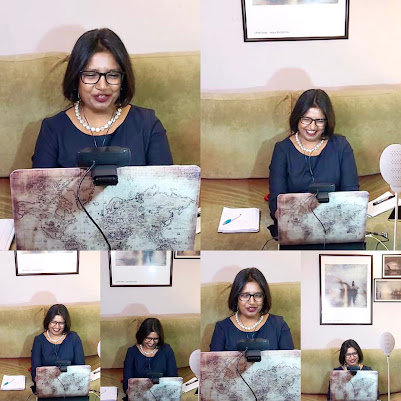
2020 has remained a challenging year for the world around and I was no exception. Personally, it was a trying year with a lot of dislocatio...
-
 2020 has remained a challenging year for the world around and I was no exception. Personally, it was a trying year with a lot of dislocatio...
 -
 In February, I wrote a short essay on India-Australia strategic partnership for the East Asia Forum . The essay, "The push and pull i...
 -
 I was recently at the Department of Political Science, Kerala University, my alma mater (I did my Masters here). Went to the Department for...