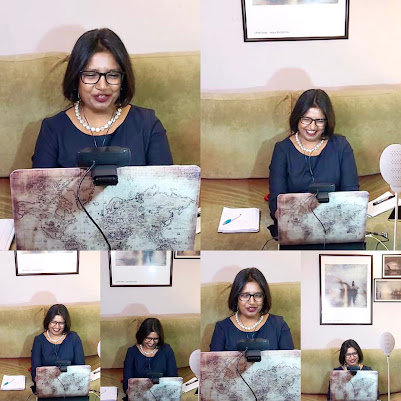
Earlier this week, I had a chat with Ankit Panda, Editor-at-Large at The Diplomat on US-India ties amid the Eastern Ladakh crisis and the COVID-19 pandemic, for the Diplomat's Asia Geopolitics podcast. In the podcast, we looked at how the US-India ties have evolved in the middle of the Sino-Indian border crisis in Ladakh crisis and the pandemic.
You can listen to The Diplomat’s Asia Geopolitics podcast on iTunes here; if you use Windows or Android, you can subscribe on Google Play here, or on Spotify here.
This podcast is a take-off from my latest column for The Diplomat's Asia Defense Blog, where I focused on the open and public support for India in its border conflcit with China. Unlike during the Doklam confrontation, this time around, there has been much larger visible and open US support for India. It is possible that this has the tacit approval of New Delhi, which would be one more indicator that the two sides are getting much more comfortable in their partnership.
I have a weekly column with the Asia Defense Blog of The Diplomat where I focus on a range of Asian strategic issues, including major power politics, nuclear security, outer space and global governance aspects. You can check out my articles here.
Showing posts with label Raji. Show all posts
Friday, July 31, 2020
Friday, May 8, 2020
The Pandemic and China Are Strengthening U.S.-India Relations, for Now - Asia Unbound, Council on Foreign Relations, 4 May 2020
In a first, I have a short essay on India-US relations for the Council on Foreign Relations blog, Asia Unbound where I guest-blogged for Alyssa Ayres. The Pandemic and China Are Strengthening U.S.-India Relations, for Now, as the title suggests, argued that the pandemic and China's aggressive behaviour are driving the US-India relations.
This post was published a few days ago, and is part of an Asia Unbound series of voices from Asia on the COVID-19 crisis, and on its implications for Asia and for Asian views of the United States. This is the ninth post in this series; the first can be found here, the second here, the third here, the fourth here, the fifth here, the sixth here, the seventh here, and the eighth here.
Despite the COVID-19 pandemic, U.S.-India relations have shown signs of continued cooperation. Officials of the two countries are in frequent contact, including President Donald J. Trump and Prime Minister Narendra Modi, and Secretary of State Mike Pompeo and his counterpart, External Affairs Minister S. Jaishankar. Concerns about China’s growing aggressiveness may be driving New Delhi and Washington closer together. But there are signs of turbulence ahead, and the outcome of the U.S. presidential election and the uncertain path of the pandemic itself make any prognosis tentative at best.
For the full essay, click here.
The United States has taken the lead in extending assistance to other countries, including India. According to a Department of State Fact Sheet issued on April 16, the State Department and the U.S. Agency for International Development (USAID) together have earmarked about $500 million dollars in emergency health, humanitarian, and economic assistance. This is in addition to State Department funding to multilateral and non-governmental organizations (NGOs) actively providing assistance during the pandemic. Washington and New Delhi have great potential for further collaboration. This crisis drives home the importance of ensuring that multilateral agencies remain effective and unbeholden to any one power. India and the United States can work together with their allies to promote neutrality, transparency and accountability in such agencies.
Both countries have a stake in ensuring that they do not cede influence to China in the provision of pandemic relief, especially to smaller countries in the region. The pursuit of influence continues unabated despite the pandemic. China’s missteps such as allowing the pandemic to spread, focusing more on shifting blame than investigating the origins of the virus, using pandemic aid for publicity, and engaging in assertive military behavior toward its smaller neighbors have helped but they only provide an opportunity, not a guarantee, for regional leadership. The United States has stepped up diplomatic consultations for cooperation with a geographically diverse group of countries, which has now been dubbed the Quad-plus because it includes South Korea, Vietnam and New Zealand in addition to the original Quad (United States, India, Australia and Japan). The crisis could help generate subsequent strategic cooperation—the original Quad grew out of multilateral cooperation after the 2004 Indian Ocean tsunami.
China’s behavior is also making this cooperation easier. Despite the crisis, China appears to be stepping up its military presence in the region. Since early February, the People’s Liberation Army (PLA) has been probing Taiwan’s air and maritime borders. The PLA Eastern Theatre Command has been particularly active, deploying fighter jets and bombers around Taiwan. According to reports, Chinese fighter planes momentarily traversed into Taiwanese airspace. China has claimed that it was only conducting military exercises though the United States has said that this was completely inappropriate. PLA air exercises have continued into April. In addition, China’s new aircraft carrier, the Liaoning, and five other warships sailed close to Taiwan’s waters in mid-April.
Meanwhile, in Southeast Asia, the PLA has been particularly aggressive toward Indonesia and Vietnam. Chinese fishing vessels accompanied by coast guard ships have been intruding in Indonesian waters off the Natuna Islands. Last week, China also established two districts on disputed territories in the South China Sea. China this week also targeted a Philippine Navy vessel that was conducting territorial defense operations and sovereignty patrol. And in a more serious incident in early April, Chinese ships hit and sank a Vietnamese fishing vessel near the Paracel Islands, leading Vietnam to issue a formal diplomatic protest. The U.S. State Department also put out a strongly worded statement, expressing serious concern at “the latest in a long string of PRC actions to assert unlawful maritime claims and disadvantage its Southeast Asian neighbors in the South China Sea.”
If COVID-19 cooperation and China’s behavior are helping to keep the momentum in U.S.-India relations, there are also some uncertainties. New Delhi is unlikely to be happy at the latest changes in U.S. immigration rules which could pose a challenge to the Indian expatriate community in the United States. New pressure on India’s budget means that India is unlikely to have enough money to buy foreign military equipment, including from the United States. Trump has been a keen promoter of U.S. arms sales and could retaliate if deals with India fall through.
But the most serious uncertainty concerns the U.S. elections in fall 2020. On one side, there appears to be a growing political consensus in the United States that China is a problem, leading to efforts by both U.S. presidential candidates to frame the other as “soft on China." This is music to India’s ears. But New Delhi has concerns about both candidates. The Democrats are perceived to have been traditionally soft on China. But Trump’s unsteady hands at the tiller is also a problem for New Delhi. His early praise for Chinese President Xi Jinping’s handling of the crisis, in particular, is seen in India as an example of his undependability. New Delhi should be most concerned about the growing chorus from both sides of aisle in the United States to draw down its global commitments. As China flexes its muscle, India is looking for more U.S. involvement, not less.
This could take several forms. At the declaratory level, Washington could emphasize that ensuring a non-hegemonic Asia is a core American interest. But the US also needs to act consistently to promote this value including by supporting countries that are threatened by coercive trade practices and by leading regional response against using force to resolve territorial disputes. Finally, the United States should also take the lead to coordinate the various minilaterals in the region in order to promote the values enshrined in the idea of the free and open Indo-Pacific.
This post was published a few days ago, and is part of an Asia Unbound series of voices from Asia on the COVID-19 crisis, and on its implications for Asia and for Asian views of the United States. This is the ninth post in this series; the first can be found here, the second here, the third here, the fourth here, the fifth here, the sixth here, the seventh here, and the eighth here.
Despite the COVID-19 pandemic, U.S.-India relations have shown signs of continued cooperation. Officials of the two countries are in frequent contact, including President Donald J. Trump and Prime Minister Narendra Modi, and Secretary of State Mike Pompeo and his counterpart, External Affairs Minister S. Jaishankar. Concerns about China’s growing aggressiveness may be driving New Delhi and Washington closer together. But there are signs of turbulence ahead, and the outcome of the U.S. presidential election and the uncertain path of the pandemic itself make any prognosis tentative at best.
For the full essay, click here.
The United States has taken the lead in extending assistance to other countries, including India. According to a Department of State Fact Sheet issued on April 16, the State Department and the U.S. Agency for International Development (USAID) together have earmarked about $500 million dollars in emergency health, humanitarian, and economic assistance. This is in addition to State Department funding to multilateral and non-governmental organizations (NGOs) actively providing assistance during the pandemic. Washington and New Delhi have great potential for further collaboration. This crisis drives home the importance of ensuring that multilateral agencies remain effective and unbeholden to any one power. India and the United States can work together with their allies to promote neutrality, transparency and accountability in such agencies.
Both countries have a stake in ensuring that they do not cede influence to China in the provision of pandemic relief, especially to smaller countries in the region. The pursuit of influence continues unabated despite the pandemic. China’s missteps such as allowing the pandemic to spread, focusing more on shifting blame than investigating the origins of the virus, using pandemic aid for publicity, and engaging in assertive military behavior toward its smaller neighbors have helped but they only provide an opportunity, not a guarantee, for regional leadership. The United States has stepped up diplomatic consultations for cooperation with a geographically diverse group of countries, which has now been dubbed the Quad-plus because it includes South Korea, Vietnam and New Zealand in addition to the original Quad (United States, India, Australia and Japan). The crisis could help generate subsequent strategic cooperation—the original Quad grew out of multilateral cooperation after the 2004 Indian Ocean tsunami.
China’s behavior is also making this cooperation easier. Despite the crisis, China appears to be stepping up its military presence in the region. Since early February, the People’s Liberation Army (PLA) has been probing Taiwan’s air and maritime borders. The PLA Eastern Theatre Command has been particularly active, deploying fighter jets and bombers around Taiwan. According to reports, Chinese fighter planes momentarily traversed into Taiwanese airspace. China has claimed that it was only conducting military exercises though the United States has said that this was completely inappropriate. PLA air exercises have continued into April. In addition, China’s new aircraft carrier, the Liaoning, and five other warships sailed close to Taiwan’s waters in mid-April.
Meanwhile, in Southeast Asia, the PLA has been particularly aggressive toward Indonesia and Vietnam. Chinese fishing vessels accompanied by coast guard ships have been intruding in Indonesian waters off the Natuna Islands. Last week, China also established two districts on disputed territories in the South China Sea. China this week also targeted a Philippine Navy vessel that was conducting territorial defense operations and sovereignty patrol. And in a more serious incident in early April, Chinese ships hit and sank a Vietnamese fishing vessel near the Paracel Islands, leading Vietnam to issue a formal diplomatic protest. The U.S. State Department also put out a strongly worded statement, expressing serious concern at “the latest in a long string of PRC actions to assert unlawful maritime claims and disadvantage its Southeast Asian neighbors in the South China Sea.”
If COVID-19 cooperation and China’s behavior are helping to keep the momentum in U.S.-India relations, there are also some uncertainties. New Delhi is unlikely to be happy at the latest changes in U.S. immigration rules which could pose a challenge to the Indian expatriate community in the United States. New pressure on India’s budget means that India is unlikely to have enough money to buy foreign military equipment, including from the United States. Trump has been a keen promoter of U.S. arms sales and could retaliate if deals with India fall through.
But the most serious uncertainty concerns the U.S. elections in fall 2020. On one side, there appears to be a growing political consensus in the United States that China is a problem, leading to efforts by both U.S. presidential candidates to frame the other as “soft on China." This is music to India’s ears. But New Delhi has concerns about both candidates. The Democrats are perceived to have been traditionally soft on China. But Trump’s unsteady hands at the tiller is also a problem for New Delhi. His early praise for Chinese President Xi Jinping’s handling of the crisis, in particular, is seen in India as an example of his undependability. New Delhi should be most concerned about the growing chorus from both sides of aisle in the United States to draw down its global commitments. As China flexes its muscle, India is looking for more U.S. involvement, not less.
This could take several forms. At the declaratory level, Washington could emphasize that ensuring a non-hegemonic Asia is a core American interest. But the US also needs to act consistently to promote this value including by supporting countries that are threatened by coercive trade practices and by leading regional response against using force to resolve territorial disputes. Finally, the United States should also take the lead to coordinate the various minilaterals in the region in order to promote the values enshrined in the idea of the free and open Indo-Pacific.
Towards A Quad-Plus Arrangement? - Perth USAsia Centre, 21 April 2020
As I mentioned in previous blog, along with my regular work at the Observer Research Foundation as a Distinguished Fellow and head of the Nuclear and Space Policy Initiative, I am also a Non-Resident Indo-Pacific Fellow at the Perth USAsia Centre for a period of 9 months starting in April. As part of this, I will be doing a series of papers, video blogs and webinars. The first of my papers is this: Towards a Quad-Plus Arrangement? which came out in the third week of April (I have been late in updating my blog).
It is probably too early to sense the shape of the post-COVID world. But there are some early hints of how international partnerships might be shaped by the crisis. Recently, senior officials of the four “Quad” countries (Australia, India, Japan and the
United States) teleconferenced about how to respond to the pandemic.
Quad meetings are no longer unusual. But this one was special because it included three additional Indo-Pacific powers:NewZealand, South Korea and Vietnam. The call, reportedly initiated by the US Deputy Secretary of State Steve Beigun, was intended to exchange notes on how these powers were tackling the COVID-19 pandemic.
But it also raises a broader question: Is this is a sign of possible expansion of the Quad mechanism, and how might such an expansion be feasible?
For the full essay, click here.
I concluded the essay with the following thoughts. Efforts to coordinate responses to COVID-19 by the Quad-Plus countries may be a means to expand the original formulation at a pace that would be comfortable to potential new members and without eliciting a Chinese rebuke. It would be hypocritical for China to oppose countries collaborating on COVID-19 when it has itself made precisely such calls. But such cooperation
also sets the stage for further Quad dialogue on other problems these countries face, potentially including security problems.
Indeed, a Quad-Plus expansion makes sense for a number of reasons. One is the common security concern these countries share regarding China’s behaviours. Each have faced Chinese pressure plays in recent years, and harbor concerns regarding China’s military and political expansion into areas they consider their ‘neighbourhood’. Additionally, none are in a position to effectively challenge China on a bilateral basis,
making minilateral cooperation with likeminded partners a better approach.
Together, these factors provide a pragmatic path to greater security cooperation via a Quad-Plus arrangement in future years. Expanding the Quad is not going to be easy, and will bring with it challenges of divergent concerns and burdensharing problems. But there is clearly an impetus for Quad expansion that will begin to find expression in coming months.
It is probably too early to sense the shape of the post-COVID world. But there are some early hints of how international partnerships might be shaped by the crisis. Recently, senior officials of the four “Quad” countries (Australia, India, Japan and the
United States) teleconferenced about how to respond to the pandemic.
Quad meetings are no longer unusual. But this one was special because it included three additional Indo-Pacific powers:NewZealand, South Korea and Vietnam. The call, reportedly initiated by the US Deputy Secretary of State Steve Beigun, was intended to exchange notes on how these powers were tackling the COVID-19 pandemic.
But it also raises a broader question: Is this is a sign of possible expansion of the Quad mechanism, and how might such an expansion be feasible?
For the full essay, click here.
I concluded the essay with the following thoughts. Efforts to coordinate responses to COVID-19 by the Quad-Plus countries may be a means to expand the original formulation at a pace that would be comfortable to potential new members and without eliciting a Chinese rebuke. It would be hypocritical for China to oppose countries collaborating on COVID-19 when it has itself made precisely such calls. But such cooperation
also sets the stage for further Quad dialogue on other problems these countries face, potentially including security problems.
Indeed, a Quad-Plus expansion makes sense for a number of reasons. One is the common security concern these countries share regarding China’s behaviours. Each have faced Chinese pressure plays in recent years, and harbor concerns regarding China’s military and political expansion into areas they consider their ‘neighbourhood’. Additionally, none are in a position to effectively challenge China on a bilateral basis,
making minilateral cooperation with likeminded partners a better approach.
Together, these factors provide a pragmatic path to greater security cooperation via a Quad-Plus arrangement in future years. Expanding the Quad is not going to be easy, and will bring with it challenges of divergent concerns and burdensharing problems. But there is clearly an impetus for Quad expansion that will begin to find expression in coming months.
Professional update: Non-Resident Indo-Pacific Fellow at the Perth USAsia Centre - April-December 2020
On the professional front, there is an update I would like to share - I am a Non-Resident Indo-Pacific Fellow with the Perth USAsia Centre from April to December this year. As part of this, I will be contributing essays on the Indo-Pacific developments, doing webinars and blogs including video ones. It is an exciting time to be doing work on the Indo-Pacific. As they say, there is never a dull moment in the Indo-Pacific. Here, you will find all the five Indo-Pacific Fellows at the Centre - one each from Australia, India, Indonesia, Japan and Vietnam.
As part of this Fellowship, I published my first Analysis Brief, examining the possibilities of a Quad-Plus arrangement. You can click here for the publication. I also did a public event with the Perth USAsia Centre on the Quad-Plus arrangement. Here is the video link for the discussions.
Thursday, July 10, 2014
Iraq's deepening crisis and India's interests, my analysis on the Iraqi crisis following the abduction of 490 Indian nurses in Mosul...
I had published another essay on the Iraq crisis following the abduction of 40 nurses and how it impacted directly India's security in Iraq and beyond. The original Indian reaction was that "the violence there is not targeted at Indian nationals. We are just caught in the cross-fire." Whatever be the rationale, whether we were purposely targeted or caught in between, this new development has changed the dynamics for India.
Thereafter, even as India was concerned about the worsening situation in Iraq, New Delhi could afford to ignore it as an internal Iraqi issue between the Sunnis and Shiites, despite the glaring fact that the atrocities committed by the Islamic State of Iraq and Syria (ISIS), an off-shoot of Al Qaeda, amounted to "war crimes," as the UN human rights head noted two days ago. But for several reasons, this is no longer the case.
For the full article, click here.
India's interests in Iraq and the region should be seen in the larger context of the seven million Indians working in West Asia, of which nearly 18,000 are in Iraq. Safety and security of this population should dominate the Indian policy. The foreign exchange earned by India through this population is also a significant factor. Therefore, any unrest in the region will have an impact on India.
Two, the fallout of any crisis in West Asia on India's energy security needs to be kept in mind. The current crisis could lead to spiralling global oil prices, but in addition, safe access to energy resources also becomes an important consideration.
Three, even though the current crisis in Iraq is often seen through a Sunni-Shia prism in the local context, the issue has a wider regional consonance. The issue needs to be seen in the context of the Shia-dominated Iran and the Sunni-dominated Saudi Arabia and how they see the current crisis as a reflection of the larger regional dynamics.
Four, the takeover by the ISIS of several Iraqi towns reflects a lack of capacity on the part of the Iraqi government and its security forces to handle the situation. In such a scenario, it is meaningless to assume that India and Iraq have excellent relations and therefore India is not a target. It may well have been that the 40 Indians were caught in between and not necessarily targeted by the ISIS, but the reality is that there is a monster in the country, who is notorious for their extreme brutality. India should consider cooperating with other States to undertake capacity building of the Iraqi security forces in order for these forces to fight terrorists more effectively in the future.
India should also consider coordinating with other major regional or extra-regional powers in determining the next course of action. To arrest the current pace of ISIS advance, there is clearly a need for military action. There has to be a simultaneous pursuit of two approaches: military strikes in the areas captured by the ISIS, and a political approach from the Iraqi government side to bring about some sort of rapprochement between the Sunni, Shia and the Kurd population. After an initial agreement among these communities, these have to be followed by a larger political accommodation wherein the other groups are brought in as part of the mainstream. This is critical because the ISIS gains, to a large extent, have been driven by Sunni bitterness at the current Iraqi political leadership.
Five, India needs to see the ISIS advance as part of the phenomena of global terrorism. India should pursue the fight against terror in a more focused manner to effect impact on the ISIS funding and terror activities.
To tackle India's current hostage crisis, India has to obviously work with the Maliki leadership but New Delhi also has to engage other regional players in bringing out a favourable outcome.
Thereafter, even as India was concerned about the worsening situation in Iraq, New Delhi could afford to ignore it as an internal Iraqi issue between the Sunnis and Shiites, despite the glaring fact that the atrocities committed by the Islamic State of Iraq and Syria (ISIS), an off-shoot of Al Qaeda, amounted to "war crimes," as the UN human rights head noted two days ago. But for several reasons, this is no longer the case.
For the full article, click here.
India's interests in Iraq and the region should be seen in the larger context of the seven million Indians working in West Asia, of which nearly 18,000 are in Iraq. Safety and security of this population should dominate the Indian policy. The foreign exchange earned by India through this population is also a significant factor. Therefore, any unrest in the region will have an impact on India.
Two, the fallout of any crisis in West Asia on India's energy security needs to be kept in mind. The current crisis could lead to spiralling global oil prices, but in addition, safe access to energy resources also becomes an important consideration.
Three, even though the current crisis in Iraq is often seen through a Sunni-Shia prism in the local context, the issue has a wider regional consonance. The issue needs to be seen in the context of the Shia-dominated Iran and the Sunni-dominated Saudi Arabia and how they see the current crisis as a reflection of the larger regional dynamics.
Four, the takeover by the ISIS of several Iraqi towns reflects a lack of capacity on the part of the Iraqi government and its security forces to handle the situation. In such a scenario, it is meaningless to assume that India and Iraq have excellent relations and therefore India is not a target. It may well have been that the 40 Indians were caught in between and not necessarily targeted by the ISIS, but the reality is that there is a monster in the country, who is notorious for their extreme brutality. India should consider cooperating with other States to undertake capacity building of the Iraqi security forces in order for these forces to fight terrorists more effectively in the future.
India should also consider coordinating with other major regional or extra-regional powers in determining the next course of action. To arrest the current pace of ISIS advance, there is clearly a need for military action. There has to be a simultaneous pursuit of two approaches: military strikes in the areas captured by the ISIS, and a political approach from the Iraqi government side to bring about some sort of rapprochement between the Sunni, Shia and the Kurd population. After an initial agreement among these communities, these have to be followed by a larger political accommodation wherein the other groups are brought in as part of the mainstream. This is critical because the ISIS gains, to a large extent, have been driven by Sunni bitterness at the current Iraqi political leadership.
Five, India needs to see the ISIS advance as part of the phenomena of global terrorism. India should pursue the fight against terror in a more focused manner to effect impact on the ISIS funding and terror activities.
To tackle India's current hostage crisis, India has to obviously work with the Maliki leadership but New Delhi also has to engage other regional players in bringing out a favourable outcome.
Dangers of the ISIS Push in Iraq... my take on the Iraq situation and what it means for the region and the US...
Last month, I wrote a short essay on the dangers of the ISIS push into Iraq and what could India and others do to bring the situation under control. ISIS' capture of most of the western and northern cities of Iraq was quick and the Iraqi armed forces abandoned their weapons and ran, leaving the ISIS to gain in military terms as well.
There have been debates whether the US should get involved and the debate is wide open. There are arguments on both sides, bringing out the pros and cons. Secretary of State John Kerry in a statement said that the President has every option including airstrikes on the table. It has also been reported that diplomats from both Iran and the US have had discussions regarding possible options in order to arrest the ISIS’ advance. Sections of the US Congress and the retired military officials have underlined the importance for the US to get involved in Iraq in order to bring about a semblance of stability in Iraq. General Paul Eaton, who was responsible for training Iraqi security forces, went to the extent of saying that Iran would be a "natural ally" in the campaign against the ISIS. Characterising the current crisis in Iraq as possibly the worst national security that the US has faced since the 9/11 attacks, Senator Lindsey Graham argued that the US must engage Iran in developing coordinated options in dealing with the situation. However, he made a distinction to say, "I don’t want Iran to dominate Iraq. And that’s where they’re headed. ... Don’t have the Iranians save Baghdad. Let us save Baghdad, so there will be a chance at a second government."
These are clearly no easy options for the US. However, the US should not look at staying in Iraq for a long haul. The US must go in with a limited military mission to arrest the spread of ISIS, thus aiding the process of bringing stability in Iraq and the region at large.
For the full article, click here.
Even though Abu Musab al-Zarqawi, the founder of ISIS, was killed in a US airstrike in 2006, the movement appears to have gained a great deal recently after establishing control over much of eastern Syria and now moving at a frightening pace into Iraq. Latest reports talked about the ISIS advancing to the outskirts of Baghdad, barely 45 minutes away from the capital. The UN human rights head Navi Pillay characterized the ISIS’ "apparently systematic series of cold-blooded executions" as near "war crimes."
ISIS is primarily a Sunni radical group that took its birth in the wake of the US invasion of Iraq in 2003. At the time of the invasion, Abu Musab al-Zarqawi, the founder of the ISIS, an Arab from Jordan, had landed on the outskirts of Baghdad with some weapons, bags full of money and a bold idea of uniting Sunni Muslims of the region through war.1 In a limited span of time, he was able to build a support base among Iraqis and then started a spate of suicide bombings and brutal execution of anyone (predominantly Shiites and Americans) he saw as a hindrance in his pursuit of establishing an Islamic Caliphate. Driven by Zarqawi’s dream of an extremist Sunni commune across the region, the ISIS believes in establishing an Islamic Caliphate across Syria, Iraq and much of the region.
Though it managed to build some local support within Iraq, the level of ISIS brutality caused backlash within the Sunni community, which led to what was called the Anbar Awakening in 2006-2007. With Anbar Awakening in motion, the Sunni tribal leaders stopped their support for Zarqawi and instead gave full backing to the US forces in an effort to wipe out the Zarqawi operatives. ISIS puts al Qaeda to shame when it comes to their extreme way of interpreting Quran and propounding a far more brutal manner of implementing Islamic law. However, the sense of alienation that exists among the Sunnis today is driving the community into the hands of the ISIS yet again. Even the veterans who were part of the Awakening movement are now extending support to the ISIS with the hope that the regime in Baghdad that is "corrupt" and "repressive" is defeated.
A major chunk of ISIS funding appears to have come from wealthy private donors in Kuwait, Qatar and Saudi Arabia, who are supposedly US allies. It is reported that the ISIS has been able to take advantage of loopholes that exist in the anti-money laundering policies in these countries.2 In the recent years, Kuwait appears to have become the financing hub for many anti-Shiite groups. Despite the US Treasury Department being in the know-how of such developments, there has been very little that has been done to deal with this situation. The US has not been particularly successful in impressing upon the Gulf leaders on this point. Meanwhile, the US has lost its credibility to some extent with President Obama not able to carry through the red line that he had set on the issue of Syrian use of chemical weapons.
Many regional experts and officials claim that the ISIS has been able to take full advantage of the worsening Sunni-Shia relations, having been able to win the support of Sunni tribal leaders. The anger and bitterness among the Sunni population towards the Shiite government in Baghdad is something that has worked in favour of the ISIS. Whether and how long this tactical deal between the ISIS and the Sunni tribes will last is a question, though. The brutality and the future plans of the ISIS may not be palatable to the Sunni tribes in the long term.
There are doubts amongst American analysts about the US role in the current crisis. Daniel Pipes, a prominent US scholar and analyst, was categorical (back in 2006) in saying that the West, including the US "cannot be tasked with resolving Sunni-Shiite differences, an abiding Iraqi problem that only Iraqis themselves can address." While this makes sense as a general sentiment, the situation is significantly different today. However, Pipes’ advice against any intervention by the West may not hold today. He had argued that "This is basically a Middle Eastern problem, and outside powers should aim to protect their own interests, not solve the Middle East’s crises. Tehran, not we, should fight ISIS." While Iran may have a more direct interest in the affairs of Iraq, particularly in the current crisis, the West cannot shun the thousands of foreigners fighting alongside the ISIS. More than 2000 Europeans are reportedly fighting in Syria and at least some are returning to Europe to take up fight against the West. The instance of a Frenchman involved in the shooting at the Brussels Jewish museum in May 2014 is a case in point. The suspect, Mehdi Nemmouche, is believed to have been trained in Syria for over a year and had joined many jihadist terrorist groups there. There are also several Americans fighting alongside the ISIS. A Forbes report highlighting this aspect said, "At least 15 Somali-American men from Minnesota have traveled to Syria to join the Islamic State of Iraq and Syria (ISIS). The group not only fights in Syria, but also recently captured the Iraqi cities of Mosul (115 km from the border between Iraq and Syria) and Tikrit (323 km from the border). The group does not recognize international borders and has a presence ranging from Syria’s Mediterranean coast to south of Baghdad."
There have been debates whether the US should get involved and the debate is wide open. There are arguments on both sides, bringing out the pros and cons. Secretary of State John Kerry in a statement said that the President has every option including airstrikes on the table. It has also been reported that diplomats from both Iran and the US have had discussions regarding possible options in order to arrest the ISIS’ advance. Sections of the US Congress and the retired military officials have underlined the importance for the US to get involved in Iraq in order to bring about a semblance of stability in Iraq. General Paul Eaton, who was responsible for training Iraqi security forces, went to the extent of saying that Iran would be a "natural ally" in the campaign against the ISIS. Characterising the current crisis in Iraq as possibly the worst national security that the US has faced since the 9/11 attacks, Senator Lindsey Graham argued that the US must engage Iran in developing coordinated options in dealing with the situation. However, he made a distinction to say, "I don’t want Iran to dominate Iraq. And that’s where they’re headed. ... Don’t have the Iranians save Baghdad. Let us save Baghdad, so there will be a chance at a second government."
These are clearly no easy options for the US. However, the US should not look at staying in Iraq for a long haul. The US must go in with a limited military mission to arrest the spread of ISIS, thus aiding the process of bringing stability in Iraq and the region at large.
For the full article, click here.
Even though Abu Musab al-Zarqawi, the founder of ISIS, was killed in a US airstrike in 2006, the movement appears to have gained a great deal recently after establishing control over much of eastern Syria and now moving at a frightening pace into Iraq. Latest reports talked about the ISIS advancing to the outskirts of Baghdad, barely 45 minutes away from the capital. The UN human rights head Navi Pillay characterized the ISIS’ "apparently systematic series of cold-blooded executions" as near "war crimes."
ISIS is primarily a Sunni radical group that took its birth in the wake of the US invasion of Iraq in 2003. At the time of the invasion, Abu Musab al-Zarqawi, the founder of the ISIS, an Arab from Jordan, had landed on the outskirts of Baghdad with some weapons, bags full of money and a bold idea of uniting Sunni Muslims of the region through war.1 In a limited span of time, he was able to build a support base among Iraqis and then started a spate of suicide bombings and brutal execution of anyone (predominantly Shiites and Americans) he saw as a hindrance in his pursuit of establishing an Islamic Caliphate. Driven by Zarqawi’s dream of an extremist Sunni commune across the region, the ISIS believes in establishing an Islamic Caliphate across Syria, Iraq and much of the region.
Though it managed to build some local support within Iraq, the level of ISIS brutality caused backlash within the Sunni community, which led to what was called the Anbar Awakening in 2006-2007. With Anbar Awakening in motion, the Sunni tribal leaders stopped their support for Zarqawi and instead gave full backing to the US forces in an effort to wipe out the Zarqawi operatives. ISIS puts al Qaeda to shame when it comes to their extreme way of interpreting Quran and propounding a far more brutal manner of implementing Islamic law. However, the sense of alienation that exists among the Sunnis today is driving the community into the hands of the ISIS yet again. Even the veterans who were part of the Awakening movement are now extending support to the ISIS with the hope that the regime in Baghdad that is "corrupt" and "repressive" is defeated.
A major chunk of ISIS funding appears to have come from wealthy private donors in Kuwait, Qatar and Saudi Arabia, who are supposedly US allies. It is reported that the ISIS has been able to take advantage of loopholes that exist in the anti-money laundering policies in these countries.2 In the recent years, Kuwait appears to have become the financing hub for many anti-Shiite groups. Despite the US Treasury Department being in the know-how of such developments, there has been very little that has been done to deal with this situation. The US has not been particularly successful in impressing upon the Gulf leaders on this point. Meanwhile, the US has lost its credibility to some extent with President Obama not able to carry through the red line that he had set on the issue of Syrian use of chemical weapons.
Many regional experts and officials claim that the ISIS has been able to take full advantage of the worsening Sunni-Shia relations, having been able to win the support of Sunni tribal leaders. The anger and bitterness among the Sunni population towards the Shiite government in Baghdad is something that has worked in favour of the ISIS. Whether and how long this tactical deal between the ISIS and the Sunni tribes will last is a question, though. The brutality and the future plans of the ISIS may not be palatable to the Sunni tribes in the long term.
There are doubts amongst American analysts about the US role in the current crisis. Daniel Pipes, a prominent US scholar and analyst, was categorical (back in 2006) in saying that the West, including the US "cannot be tasked with resolving Sunni-Shiite differences, an abiding Iraqi problem that only Iraqis themselves can address." While this makes sense as a general sentiment, the situation is significantly different today. However, Pipes’ advice against any intervention by the West may not hold today. He had argued that "This is basically a Middle Eastern problem, and outside powers should aim to protect their own interests, not solve the Middle East’s crises. Tehran, not we, should fight ISIS." While Iran may have a more direct interest in the affairs of Iraq, particularly in the current crisis, the West cannot shun the thousands of foreigners fighting alongside the ISIS. More than 2000 Europeans are reportedly fighting in Syria and at least some are returning to Europe to take up fight against the West. The instance of a Frenchman involved in the shooting at the Brussels Jewish museum in May 2014 is a case in point. The suspect, Mehdi Nemmouche, is believed to have been trained in Syria for over a year and had joined many jihadist terrorist groups there. There are also several Americans fighting alongside the ISIS. A Forbes report highlighting this aspect said, "At least 15 Somali-American men from Minnesota have traveled to Syria to join the Islamic State of Iraq and Syria (ISIS). The group not only fights in Syria, but also recently captured the Iraqi cities of Mosul (115 km from the border between Iraq and Syria) and Tikrit (323 km from the border). The group does not recognize international borders and has a presence ranging from Syria’s Mediterranean coast to south of Baghdad."
Friday, April 19, 2013
A review of my book, Clashing Titans, in Tribune... written by Brig. Gurmeet Kanwal....
Here's a review of my latest book, Clashing Titans: Military Strategy and Insecurity Among Asian Great Powers, written by Brig. Gurmeet Kanwal and published in Tribune, last Sunday, April 14, 2013.
The political, economic and military interplay between the major Asian powers, including China, India, Japan, Russia and the US, will define the emerging contours of the geo-strategic landscape. In this context, Rajeswari Rajagopalan's meticulously researched book is timely. It provides a uniquely Indian perspective on a subject of immense significance.
It takes stock of the military modernisation programmes of major Asian powers, attempts to understand their military strategies, provides an analysis of the mutual suspicions and insecurities being generated by the emerging military postures and theorises how these military powers as well as India might interact in future. Individual chapters look into the current threats and challenges confronting the major Asian powers, the military strategies adopted by them, the modernisation efforts underway to respond to emerging threats and the likely effectiveness of the planned responses.

PRESIDENT OBAMA announced in October 2011, that the United States will rebalance its global strategy and “pivot to Asia”. Soon after that, Defence Secretary Leon Panetta indicated that the bulk of the US Navy will redeploy from the Atlantic to the Pacific Ocean. These moves are widely seen to be designed to counter China's growing power and influence as well as marked assertiveness in its maritime neighbourhood. In response to China's rise and uncharacteristic belligerence, its neighbours have begun to upgrade their military capabilities and simultaneously reinforce their relations.
The political, economic and military interplay between the major Asian powers, including China, India, Japan, Russia and the US, will define the emerging contours of the geo-strategic landscape. In this context, Rajeswari Rajagopalan's meticulously researched book is timely. It provides a uniquely Indian perspective on a subject of immense significance.
It takes stock of the military modernisation programmes of major Asian powers, attempts to understand their military strategies, provides an analysis of the mutual suspicions and insecurities being generated by the emerging military postures and theorises how these military powers as well as India might interact in future. Individual chapters look into the current threats and challenges confronting the major Asian powers, the military strategies adopted by them, the modernisation efforts underway to respond to emerging threats and the likely effectiveness of the planned responses.
The author notes that the US has contributed positively to peace and stability in Asia through power projection, the forward presence of its armed forces and unwavering military alliances, primarily with Japan, South Korea and Taiwan. However, America's capacity to maintain its regional pre-eminence is gradually starting to erode, even as China's military capabilities are growing rapidly stronger. The author correctly notes that China's anti-access and area denial strategies —particularly the threat posed to carrier battle groups by the deployment of the DF-21D ASBM (anti-ship ballistic missile) in large numbers — are rapidly undermining US responsiveness.
While analysing how China's military modernisation and evolving strategies affect Indian security, the author states that India's standing within South Asia has been adversely impacted, that China might make new territorial claims. The emergence of a possible G-2 (China-US) scenario in international security will have a negative impact and that a growing Russia-China partnership will have “tactical and strategic implications for India.” While the attempt at G-2 cooperation in Asia was an early blunder in President Obama's first administration, the others are low- probability and low-impact scenarios.
The core truth facing India is that a militarily powerful China, which is also an economic powerhouse, continues to remain its foremost military threat as long as the unresolved territorial and boundary dispute between the two countries is not resolved satisfactorily. India must upgrade its military strategy from dissuasion to deterrence and speed up its own military modernisation if a disaster like that of 1962 is to be avoided in the eventuality that there is another border conflict between the two countries
The political, economic and military interplay between the major Asian powers, including China, India, Japan, Russia and the US, will define the emerging contours of the geo-strategic landscape. In this context, Rajeswari Rajagopalan's meticulously researched book is timely. It provides a uniquely Indian perspective on a subject of immense significance.
It takes stock of the military modernisation programmes of major Asian powers, attempts to understand their military strategies, provides an analysis of the mutual suspicions and insecurities being generated by the emerging military postures and theorises how these military powers as well as India might interact in future. Individual chapters look into the current threats and challenges confronting the major Asian powers, the military strategies adopted by them, the modernisation efforts underway to respond to emerging threats and the likely effectiveness of the planned responses.

PRESIDENT OBAMA announced in October 2011, that the United States will rebalance its global strategy and “pivot to Asia”. Soon after that, Defence Secretary Leon Panetta indicated that the bulk of the US Navy will redeploy from the Atlantic to the Pacific Ocean. These moves are widely seen to be designed to counter China's growing power and influence as well as marked assertiveness in its maritime neighbourhood. In response to China's rise and uncharacteristic belligerence, its neighbours have begun to upgrade their military capabilities and simultaneously reinforce their relations.
The political, economic and military interplay between the major Asian powers, including China, India, Japan, Russia and the US, will define the emerging contours of the geo-strategic landscape. In this context, Rajeswari Rajagopalan's meticulously researched book is timely. It provides a uniquely Indian perspective on a subject of immense significance.
It takes stock of the military modernisation programmes of major Asian powers, attempts to understand their military strategies, provides an analysis of the mutual suspicions and insecurities being generated by the emerging military postures and theorises how these military powers as well as India might interact in future. Individual chapters look into the current threats and challenges confronting the major Asian powers, the military strategies adopted by them, the modernisation efforts underway to respond to emerging threats and the likely effectiveness of the planned responses.
The author notes that the US has contributed positively to peace and stability in Asia through power projection, the forward presence of its armed forces and unwavering military alliances, primarily with Japan, South Korea and Taiwan. However, America's capacity to maintain its regional pre-eminence is gradually starting to erode, even as China's military capabilities are growing rapidly stronger. The author correctly notes that China's anti-access and area denial strategies —particularly the threat posed to carrier battle groups by the deployment of the DF-21D ASBM (anti-ship ballistic missile) in large numbers — are rapidly undermining US responsiveness.
While analysing how China's military modernisation and evolving strategies affect Indian security, the author states that India's standing within South Asia has been adversely impacted, that China might make new territorial claims. The emergence of a possible G-2 (China-US) scenario in international security will have a negative impact and that a growing Russia-China partnership will have “tactical and strategic implications for India.” While the attempt at G-2 cooperation in Asia was an early blunder in President Obama's first administration, the others are low- probability and low-impact scenarios.
The core truth facing India is that a militarily powerful China, which is also an economic powerhouse, continues to remain its foremost military threat as long as the unresolved territorial and boundary dispute between the two countries is not resolved satisfactorily. India must upgrade its military strategy from dissuasion to deterrence and speed up its own military modernisation if a disaster like that of 1962 is to be avoided in the eventuality that there is another border conflict between the two countries
Tuesday, February 7, 2012
My interview with The Diplomat .... on China's aircraft carrier, India's subs, missile defense options.....

Here's an interview of mine in the Diplomat published today ... touching upon issues including China's aircraft carrier, US-India relations and India's subs.
For the full interview, click here.
Meet The Diplomat Writers
February 7, 2012 By The Diplomat
The Diplomat speaks with Rajeswari Pillai Rajagopalan, a senior fellow at the Observer Research Foundation in New Delhi, who answers readers’ questions on China’s aircraft carrier, missile defense and India’s attack submarine.
Mark Sharpis (LinkedIn):
There has been much written and debated regarding China’s new carrier, the ex-Soviet carrier Varyag. What do you make of the carrier and its current capabilities? Do you see China’s new carrier as a threat to India? Do you feel it could be used as a platform to build future vessels?
We don’t know very much about the carrier, but it seems in line with what the PLA Navy’s Academic Research Institute had been stating, that it will be a “conventionally powered medium-sized carrier that would be equipped with Chinese engines, aircraft, radar and other hardware.” While there was no doubt that China will have its own aircraft carrier someday, external assessments as far as the timeline was concerned have been wrong. Many of the western assessments had calculated that Beijing would have its first carrier by 2012 or so. However, today, the aircraft carrier is only undergoing initial sea trials, and still testing its engines, navigation equipment, electronics, fire control and maintenance systems, according to published reports. But they are a long way away from carrying combat planes. It will be years before they have a carrier battle group comprising a consolidated group of frigates, destroyers, submarines and other support vessels.
Having said that, what does an aircraft carrier mean for China? Having an aircraft carrier in its arsenal doesn’t mean much as yet, and China is years away from being capable of even effective sea denial strategy in the East Asian maritime region. However, as a rising power, China will possess such capabilities and more in the future. If there are no serious hitches, the PLAN is scheduled to induct the carrier into service by October 2012, though this sounds ambitious.
China’s aircraft carrier plans are an element of its assertive naval posturing that it has been displaying vis-a-vis its neighbors in recent years – be it the East China Sea or the South China Sea. In fact, an aircraft carrier would provide Beijing with greater coercive means for enforcing its claims in these two seas. Reportedly, a Chinese defense ministry-run website suggested that the carrier should handle territorial disputes as well. A PLA Daily article, too, noted that in a theater like the South China Sea, a carrier would provide them the ability to apply significant air-to-ground firepower during military missions, while not being affected by geographical restrictions. They see the aircraft carrier as a “mobile maritime airport.”
What does the Chinese aircraft carrier mean for India and other neighbors? In the first place, it would induce caution in other maritime powers in the region, particularly India, the U.S. and Japan. China’s submarine force already has produced this effect to some extent on these powers; the aircraft carrier would compound it. As for the Southeast Asian countries, the Chinese aircraft carrier would be a display of power and prestige. In fact, a PLA Daily article said that the aircraft carrier has far greater political significance than military significance. This is particularly important given that until a few years back, the PLAN was the weakest wing of the Chinese military. But this has changed now with greater attention in favor of the naval and air wing of the military. Chinese strategists seem to believe that aircraft carriers are important if they want to have effective maritime power projection capabilities, as opposed to purely defensive tasks. Display of power and prestige is important both for internal and external audiences.
Manish Kumar (LinkedIn):
There has been speculation in the media that the United States and/or Europe may wish to work with India on missile defense technology. Do you feel such collaboration is possible? What benefits would it bring to India as well as its potential partners?
While India had traditionally opposed missile defense, it now acknowledges its utility and is developing it publicly given the short- and medium-range missile threats from both Pakistan and China. In essence, though Indian missile defense architecture isn’t yet settled, India appears to be planning to establish a multi-layered missile defense system. It has been reported that the system will include a huge network of advanced notification sensors, command centers and anti-missile land- and sea based missile batteries. However, we must remember that defense scientists have made many tall claims on a number of areas but have delivered very little. So though the interest in missile defense and in building domestic systems is clear, that doesn’t denote that this will be successful.
While India has been making efforts to develop a missile defense system indigenously, it has also sought foreign partners. In this regard, partnering with the U.S. may be particularly important. This was best evident in India’s reaction to President Bush’s NMD speech in May 2001. In contrast to the strident criticism to the United States’ Strategic Defense Initiative in the 1980s, India had adopted a much more nuanced and considered position that was in recognition of the utility of these systems in the Indian context. The changed stance was also based on the assumption that it might facilitate high-tech missile defense cooperation in addition to currying favor with Washington.
The most serious problem that India seems to face is unclear political direction. There appears to be no clear direction about whether India really wants to build such a system (either indigenously or imported) and no apparent considerations of the financial and strategic consequences of such a move. In the absence of such political direction, India’s defense research agencies are on auto-pilot, making grandiose plans, but their feasibility is unclear yet.
Harry Kazianis:
With your research agenda looking at U.S. missile defense, do you advocate for a specific missile defense that is better than others? Do you feel the SM-2 or SM-3 would offer the United States and its potential partners the best defense against today’s expanding anti-ship and cruise missile technologies? Do you see an exotic technology like rail guns or something on the horizon offering better protection?
I’m not even sure that missile defenses will be useful or necessary in the Indian context. And questions about specific systems have to wait until the purposes of BMDs are defined in the Indian context: are they for point defense or national defense? If for point defense (which is obviously more feasible) how many ‘points’ will be covered – just the National Command Authority (NCA) or other vital targets such as major population centers or strategic areas? Without even the most basic architectural questions resolved, it’s difficult to consider specific systems.
Stewart Walters (LinkedIn):
The United States has recently announced various budget cuts to its armed forces. Will America be able to “pivot” to the Pacific with such cuts being considered? If America is to truly pivot to the Asia-Pacific/Indo-Pacific, wouldn’t it need to increase the size of its Navy?
While the U.S. is undertaking major cuts in its defense expenditure, one thing has been made clear repeatedly in the last few months: the U.S. is back in Asia for good. Most recently, outlining the challenges, priorities and opportunities in the new U.S. defense strategy, Sustaining U.S. Global Leadership: Priorities for 21st Century Defense, President Obama said that while U.S. interests are global, its security and economic interests are intertwined with developments in the region, from Western Pacific and East Asia into the Indian Ocean region and South Asia. Therefore, the U.S. presence and influence in the Asia Pacific region is seen as necessary “rebalancing.” After being stretched too thin for a while, in both Afghanistan and Iraq, the U.S. is now attempting to rationalize its defense strategy. In fact, the changing geopolitical circumstances and fiscal compulsions dictate new dynamics to this strategy.
While budget pressures will make it difficult for the U.S., the “pivot” is more a political statement than one about the state of the U.S. military. I don’t think the U.S. lacks military capabilities in the region. While more might certainly be good for the U.S., it’s also a fine balance between the domestic economic requirements and military spending. In addition, as China strengthens, we are likely to see its neighbors step up their military efforts. I think they would realize now that they can’t entirely depend on American efforts alone. This additional regional capability should reduce slightly the burden on the U.S. also.
Jason Miks:
Where do you see U.S.-India relations going in the next ten years? Do you feel the U.S. and India will enter in some sort of Alliance structure? Will India stay away considering its past leadership in such ideas like the Non-Aligned Movement?
Since the conclusion of the U.S.-India nuclear deal, both Washington and New Delhi have been drifting. With the nuclear deal over, U.S. and India need another big idea to power the relationship over the next several years. Without such a political initiative at the highest levels, U.S.-India relations threaten once again to wallow in bureaucratic inertia. Space cooperation, cooperation in advanced technologies and managing the Indo-Pacific are potential areas that would bring the two sides closer.
In Washington, there’s significant disappointment on a number of issues including India’s nuclear liabilities bill, which for all practical purposes prevents the U.S. nuclear industry from participating in India’s civilian nuclear sector; and the Indian decision to reject two American competitors from the Indian Air Force’s lucrative Medium Multi Role Combat Aircraft (MMRCA) deal. In Delhi, on the other hand, there’s unhappiness at what is seen as American pressure for greater defense cooperation. These issues suggest that all is not well with U.S.-India relations.
However, there are several issues such as the global war on terrorism, the future of Pakistan-Afghanistan, managing the Asia-Pacific including maritime security and the protection of sea lines of communication that bind the two countries for the foreseeable future. Meanwhile, the more important aspect isn’t to lose sight of the importance of this bilateral relationship and hence invest time, effort and resources to nurture it.
While U.S.-India relations are likely to mature further and grow into a strong partnership, it’s unlikely that New Delhi will posture itself as an “ally” in the classical sense of the term. For that matter, the U.S. itself is moving away from the typical traditional alliance structure to more fluid strategic partners and coalitions of the willing.
While there are a few proponents of non-alignment in New Delhi, in reality, non-alignment was always more of a declaratory than a real policy. India has been trying hard to shed this policy and move into building partnerships with the west and the U.S. in particular, evident in the U.S.-India nuclear deal. But India also values its “strategic autonomy.” We should expect that India will cooperate with the United States and others on some areas, such as seeking a balance in Asia, but would not formally align with the U.S. But because the balance in the Asian region is also in a flux, India, like others, won’t make long-term bets. Paradoxically, it’s China’s rise that might dictate India’s strategy: if China should falter, there will be less pressure to cooperate with the U.S. and vice-versa.
Sandeep Sharma (Facebook):
Russia has just completed the transfer of an Akula II Nuclear Attack Submarine to India on a ten year lease. What knowledge and experience can India gain from such a move? How much of a benefit will it bring to India’s own nuclear submarine program?
INS Chakra is important for a variety of reasons. First of all, the Indian Navy will be operating a nuclear submarine after a gap of about twenty years; the last one, again Russian-leased, a Charlie II class vessel, was operated during 1988-1991. Operating this new Akula II class vessel will benefit the Indian Navy tremendously in training a new batch of submariners in nuclear operations.
While India can learn some of these lessons once its own nuclear-powered submarines come in, this lease offers India the option of getting a head start. In addition, nuclear submarine operations are a recently developed maritime skill, somewhat like carrier operations, and only a few countries have such capacity. The Indian Navy has an opportunity to learn these skills from those with experience rather than re-inventing the wheel very slowly. But most importantly, the Navy will be able to learn and apply lessons learnt to its own domestic submarine development program. And though there have been several controversies surrounding the Russian submarines, including the one that’s being leased to India, it’s important to bear in mind that there aren’t very many other countries that are willing to lease India a nuclear-powered submarine. So there are multiple benefits.
http://the-diplomat.com/author-spotlight/2012/02/07/meet-the-diplomat-writers-11/
For inquiries, please contact The Diplomat at info@the-diplomat.com
Wednesday, November 30, 2011
Why the US Needs India's Air Force ... my take on US-India military ties ... in today's The Diplomat

Here's an article of mine on US-India military ties, arguing for greater engagement between the Indian Air Force and the US Air Force. This has been published today as the lead article in The Diplomat.
Until now, the flag-bearers of U.S.-Indian military cooperation have been the two countries’ navies, a point that was highlighted during the response to the 2005 tsunami and subsequent reconstruction operations. In contrast, while there have been some joint exercises between their two air forces, the rationale for air force-to-air force cooperation appears to be neither understood nor appreciated in either capital.
During his visit to India last November, U.S. President Barack Obama characterized relations with India as “one of the defining and indispensable partnerships of the 21st century.” Indian Prime Minister Manmohan Singh, in turn, stated that India had “decided to accelerate the deepening of our ties and to work as equal partners in a strategic relationship that will positively and decisively influence world peace, stability and progress.” Arguing that cooperation extended to India’s immediate neighborhood, Singh said the two countries “have a shared vision of security, stability and prosperity in Asia based on an open and inclusive regional architecture.”
But if the bilateral relationship really as is important as the two leaders suggest, then there’s undoubtedly a need for greater strategic synergy. In particular, the two countries’ militaries need to understand each other better if they are to work together for regional and global peace.
Until now, the flag-bearers of U.S.-Indian military cooperation have been the two countries’ navies, a point that was highlighted during the response to the 2005 tsunami and subsequent reconstruction operations. In contrast, while there have been some joint exercises between their two air forces, the rationale for air force-to-air force cooperation appears to be neither understood nor appreciated in either capital.
Indian strategic planners seem to be in broad agreement with their U.S. counterparts in identifying the big strategic challenges in the Asia-Pacific region, yet New Delhi has been reluctant to develop joint approaches in addressing many of these challenges.
The hope is, of course, that even if India is hesitant now, that it may change its mind over the next decade. After all, India’s interests, and its incapacity to address the challenges it faces on its own, seem bound to drive it towards the United States and Asian partners such as Japan and Australia.
Certainly, former U.S. President George W. Bush saw India as a significant pole in Asia, and close ties with India as being in U.S. interests – something that the Obama administration also seems to have recognized. Such views have prompted the United States to develop more formal defense cooperation and to talk about India in terms reserved for U.S. allies (something that causes some discomfort in New Delhi).
The most frequently cited reason for Washington’s interest in India is as a balancer to China, but this view is more complicated than many assume. For a start, the United States has a stake in the ongoing Sino-Indian border dispute. Although the U.S. is yet to take a position on the broader boundary and territorial dispute between the two countries, it certainly wouldn’t be in the interests of the United States to see a conflict break out – and especially to see India lose face in a military confrontation. China decided to teach India a lesson in their brief war in 1962. If this were repeated today, though, the U.S. would also be adversely affected as India’s perceived value as a regional ally would be diminished. A Chinese victory would also raise the question in the minds of smaller states over what hope they have in standing up to China if the United States stood by and watched as a major ally such as India was picked on. Such worries would undoubtedly undermine the United States’ position in Asia, and make China’s neighbors more susceptible to coercion.
But it’s not just about the negatives – India’s airpower can help underpin U.S. Pacific forces indirectly. For a start, a strong Indian Air Force would likely prompt China to focus at least part of its air power away from the Pacific and on the Tibet region. In addition, the Indian Air Force could also tip the scales in the Indo-Pacific by reducing the burden on the U.S. Air Force and providing security in the global commons. For instance, with a single air refueling, India’s SU-30MKI’s combat radius can include either the Straits of Malacca or the Persian Gulf.
Of course, it’s an open question whether India is willing to take such proactive steps. But co-operating more with the United States will help India feel more comfortable with future joint operations.
The reality is that both countries’ air forces face common threats, meaning it would benefit both to share data on a more regular basis and plan joint responses to any problems. The Indian Air Force, for instance, faces threats in its Northeastern sector similar to those facing the United States in the Western Pacific, namely ballistic missiles, advanced integrated air defense systems (IADS), 4th and 5th generation fighters, and increasingly sophisticated Chinese air-to-air missile and electronic warfare capabilities. All these developments increasingly impinge on both India and the United States, and it makes sense for the two to boost co-operation and learn lessons from each other’s experiences in the region.
Similarly, given the growing trend of India procuring U.S. weapons and equipment, greater engagement between their air forces would be particularly beneficial. Joint operations on democracy promotion, humanitarian missions, post disaster management and reconstruction are all ideal areas for joint operations.
But for any of this to occur, India must first recognize the potential for it to become a net provider of constructive airpower in the Indian Ocean Region. If India’s procurement plans go as planned, it could have a modern air force that will be highly capable of anything from disaster relief and humanitarian assistance to providing lethal combat air support.
At the end of the day, if India wants to sit at the high table of international diplomacy, it should be prepared to shoulder greater responsibilities and shed its risk averse foreign policy. Ramping up its air force co-operation seems a good place to start.
Friday, November 4, 2011
Shared Goals, Converging Interests: A Plan for U.S.-Australia-India Cooperation in the Indo-Pacific: A Joint Report from Heritage, Lowy & ORF

Here's a quick synopsis of "Shared Goals, Converging Interests: A Plan for U.S.-Australia-India Cooperation in the Indo-Pacific" is a joint project report from the Heritage Foundation, the Lowy Institute for International Policy and the ORF, launched at the Lowy today and going to be launched at the ORF on November 07. The report has six authors -- Lisa Curtis, Walter Lohman, Rory Medcalf, Lydia Powell, Andrew Shearer -- including me.
The U.S., Australia, and India face common challenges and opportunities in the Indo-Pacific region that are defined by their shared values and interests. These include sea-lane security, counterterrorism, nonproliferation, among others. A formal trilateral dialogue gives these three countries an opportunity to understand and act together to address current and future challenges more effectively. Such an attempt to arrive at a mutual understanding of each others' concerns will help promote the Indo-Pacific as an area conducive to economic and political stability, security, free and open trade and democratic governance.
For the full report, click here.
Sunday, August 7, 2011
How to Deal with China -- A Viewpoint from India ... my OpEd in yesterday's Mainichi daily ....
Subscribe to:
Posts (Atom)
2020 - A challenging year yet a satisfying year, professionally
2020 has remained a challenging year for the world around and I was no exception. Personally, it was a trying year with a lot of dislocatio...
-
2020 has remained a challenging year for the world around and I was no exception. Personally, it was a trying year with a lot of dislocatio...
-
In February, I wrote a short essay on India-Australia strategic partnership for the East Asia Forum . The essay, "The push and pull i...
-
I was recently at the Department of Political Science, Kerala University, my alma mater (I did my Masters here). Went to the Department for...


.jpg)