Showing posts with label Quad-Plus Arrangement. Show all posts

Tuesday, January 26, 2021

2020 - A challenging year yet a satisfying year, professionally

2020 has remained a challenging year for the world around and I was no exception.  Personally, it was a trying year with a lot of dislocations.  Nevertheless, it has been a satisfying year, professionally speaking.  
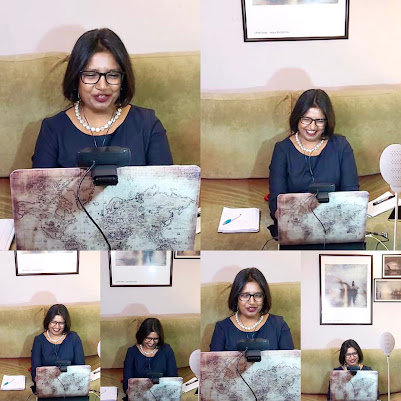


In March 2020, I was offered to join the Perth USAsia Centre as part of their inaugural Indo-Pacific Fellow programme for a period of nine months.  While I represented India, there were colleagues, one each from Australia, Japan, Indonesia and Vietnam.  It was a very fulfilling experience.  As part of the fellowship, I did a number of essays and webinars: Towards A Quad-Plus Arrangement?; Uneasy Contradictions Continue in India's Strategic EngagementsCountering ChineseAssertiveness: India’sChanging Posture in the Indian Ocean; and a forthcoming one, looking at how India-Australia relations will continue to get stronger in the face of an aggressive China.  

I got a peer reviewed journal article, "India's Emerging Space Assets and Nuclear-Weapons Capabilities" published in The Non-proliferation Review in March 2020.  In this article, I argue that over the last five decades, India’s nuclear and space programs have gone through several phases, from collaboration to divorce to supportive. An interplay of two factors determined the nature of the relationship. One was the state of India’s nuclear-weapon program. The second was international conditions, especially India’s relationship with the nuclear-nonproliferation regime. In the early decades, because of the rudimentary nature of India’s nuclear and space programs, the relationship was collaborative, since the rocket technology being developed was a necessary adjunct to the nuclear-weapon program. Subsequently, as India’s rocketry capabilities and nuclear-weapon program began to mature and concerns about international sanctions under the non-proliferation regime began to grow, the two programs were separated. The Indian rocketry program was also divided, with the civilian-space and ballistic-missile programs clearly demarcated. After India declared itself a nuclear-weapon state in 1998 and the programs matured, the relationship has become more supportive. As the two programs mature further, this relationship is likely to deepen, as the nuclear-weapon program requires space assets to build a robust and survivable nuclear deterrent force.  

In May 2020, the Office of Principal Scientific Adviser to the Government of India and the Department of Science and Technology invited me to be part of the process of formulating India's new Science, Technology, and Innovation Policy (STIP 2020).  As part of the STIP 2020 policy drafting exercise, 21 thematic groups (TGs) were constituted and I was asked to be a member and Co-Chair of the TG-Strategic Technologies.  It was such an honour and privilege for me to part of this exercise, discussing and coming up with recommendations on India's strategic technologies.  The report should be out within a few months, I guess.  


In October 202, I was invited to be part of the Editorial Board of Asian Security.  It is one of the top ranking journals on various aspects of national and international security in Asia.  I am honoured and delighted to be joining the journal in this capacity.  

In November 2020, I was part of the Bloomberg-Intelligence Squared US debate, "That's Debatable - Is A U.S.-China Space Race Good for Humanity?".  The debate was aired on November 7, 2020 and it is available at: https://www.intelligencesquaredus.org/debates/us-china-space-race-good-humanity.  American theoretical physicist, Prof. Michio Kaku and I argued against the motion, and Prof. Avi Loeb and Bidhushi Bhattacharya argued for the motion, and so well-moderated by John Donvan.  This was so much fun and we won the debate.  

I thought I will highlight some of my professional activities here but I have updated my blog with most of these developments on a reasonably regular basis.  

Wednesday, August 12, 2020

Business Now Asia Pacific (BNAP) Today Interview on India-China relations post-Galwan and other developments including Quad- July 15, 2020

On July 15, I did an interview with Australia-based Business Now Asia Pacific (BNAP) Today on the India-China Galwan clash, where I argued that the Galwan clash is pushing a major shift in India’s security and foreign policies and how the changing Sino-Indian relationship is influencing India’s relations with QUAD and QUAD Plus countries.


For the full interview, click here.


Some of the major points I made include:

1. Difficult to imagine that it will be business as usual after Galwan.

2. India has shown growing commitment to groupings such as the Quad, which has now been upgraded to ministerial level engagements; Quad Plus in the Covid context; Australia could be invited to the Malabar naval exercises.

3. India is yet to make a decision on the 5G but in all likelihood, Huawei will be blocked. Even prior to the Galwan clash, India had its apprehensions but after the last month clash, signing up with China is extremely unlikely.

4. India’s pharma industry will be affected for instance because we still buy a lot of the chemicals from China. Like I said, India will need to bite the bullet and go through some hard times because the economic impact will be significant.

5. Here is the need for the Indo-Pacific powers to come together to take decisions to consciously diversify their over-dependence on China and engage with each other even in the face of some difficulties.

Friday, May 8, 2020

Towards A Quad-Plus Arrangement? - Perth USAsia Centre, 21 April 2020

As I mentioned in previous blog, along with my regular work at the Observer Research Foundation as a Distinguished Fellow and head of the Nuclear and Space Policy Initiative, I am also a Non-Resident Indo-Pacific Fellow at the Perth USAsia Centre for a period of 9 months starting in April. As part of this, I will be doing a series of papers, video blogs and webinars. The first of my papers is this: Towards a Quad-Plus Arrangement? which came out in the third week of April (I have been late in updating my blog).


It is probably too early to sense the shape of the post-COVID world. But there are some early hints of how international partnerships might be shaped by the crisis. Recently, senior officials of the four “Quad” countries (Australia, India, Japan and the
United States) teleconferenced about how to respond to the pandemic.

Quad meetings are no longer unusual. But this one was special because it included three additional Indo-Pacific powers:NewZealand, South Korea and Vietnam. The call, reportedly initiated by the US Deputy Secretary of State Steve Beigun, was intended to exchange notes on how these powers were tackling the COVID-19 pandemic.

But it also raises a broader question: Is this is a sign of possible expansion of the Quad mechanism, and how might such an expansion be feasible?

For the full essay, click here.


I concluded the essay with the following thoughts. Efforts to coordinate responses to COVID-19 by the Quad-Plus countries may be a means to expand the original formulation at a pace that would be comfortable to potential new members and without eliciting a Chinese rebuke. It would be hypocritical for China to oppose countries collaborating on COVID-19 when it has itself made precisely such calls. But such cooperation
also sets the stage for further Quad dialogue on other problems these countries face, potentially including security problems.

Indeed, a Quad-Plus expansion makes sense for a number of reasons. One is the common security concern these countries share regarding China’s behaviours. Each have faced Chinese pressure plays in recent years, and harbor concerns regarding China’s military and political expansion into areas they consider their ‘neighbourhood’. Additionally, none are in a position to effectively challenge China on a bilateral basis,
making minilateral cooperation with likeminded partners a better approach.

Together, these factors provide a pragmatic path to greater security cooperation via a Quad-Plus arrangement in future years. Expanding the Quad is not going to be easy, and will bring with it challenges of divergent concerns and burdensharing problems. But there is clearly an impetus for Quad expansion that will begin to find expression in coming months.

Professional update: Non-Resident Indo-Pacific Fellow at the Perth USAsia Centre - April-December 2020

On the professional front, there is an update I would like to share - I am a Non-Resident Indo-Pacific Fellow with the Perth USAsia Centre from April to December this year. As part of this, I will be contributing essays on the Indo-Pacific developments, doing webinars and blogs including video ones. It is an exciting time to be doing work on the Indo-Pacific. As they say, there is never a dull moment in the Indo-Pacific. Here, you will find all the five Indo-Pacific Fellows at the Centre - one each from Australia, India, Indonesia, Japan and Vietnam.


As part of this Fellowship, I published my first Analysis Brief, examining the possibilities of a Quad-Plus arrangement. You can click here for the publication. I also did a public event with the Perth USAsia Centre on the Quad-Plus arrangement. Here is the video link for the discussions.

2020 - A challenging year yet a satisfying year, professionally

2020 has remained a challenging year for the world around and I was no exception.  Personally, it was a trying year with a lot of dislocatio...