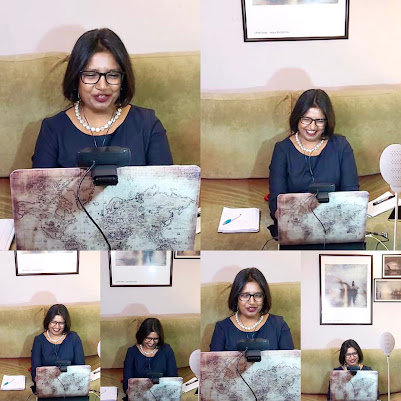
In an article for the Observer Research Foundation (ORF), "The logic behind calling out “manels”," Sylvia Mishra and I question why there are women behind the scenes but not in the discussion.
The global pandemic and the lockdown that followed have transformed our way of life and the way we conduct our work. ‘Work from home’ (WFH) has gained salience and the concept has precipitated debate about its benefits and challenges. One of the important changes has been panel discussions, roundtables and seminars that are all now conducted online via different digital media platforms. Web-based discussions bring several benefits, but they also have severe limitations — the lack of opportunities to build interpersonal relations being one. But it has also afforded a chance for those interested to digitally participate and attend lectures and discussions (sometimes several webinars a day) anywhere in the world from the comforts of their homes. Webinars have also brought into sharper focus the composition of panels and has broadened the discussions on who and which experts get a seat at the table.
For the full essay, click here.
During the last three months, for instance, in several of the conferences and webinars, it is increasingly evident that the composition of the panelists is heavily skewed and mostly consists of men. “Manel” is a term that is often used to refer a panel which consists entirely of men. The idea of manels is not new. Nor are the efforts to call out manels. Repeated efforts to engage organisers and convey the message of making panels more diverse has met with scant success. The absence of women means that significant expertise is lost simply because of gender bias. Manels also suffer from absence of balance and inclusiveness. Diversity, balance and inclusiveness are critical for more nuanced debates and discussions on any subject.
The authors of this article have been at the forefront of initiatives to make foreign policy and security studies diverse and balanced mainly because the absence of women is a loss of expertise in important debates but also because it short-changes some experts simply because they are women. This is particular true in foreign policy and security studies, a field dominated by men around the world. But it’s time for change.
First, conference organisers who decide whom to call as experts need to be aware that there are a number of women experts who are equally, if not better qualified, to engage in discussions on these issues. Of course, the situation is actually worse because this often happens despite awareness of women experts. Organisers tend to consciously or unconsciously pass over them despite their acknowledged expertise. Highlighting the works of women experts and promoting visibility via conferences and panels is essential because these habits are unlikely to be broken unless consciously exposed.
Second, by leaving women out of the conversation, there is a two-fold disservice – first, unfairness: a lack of acknowledgement of women’ work including their publications and two, limiting new ideas and creative thinking on foreign policy and security challenges. This is a widespread problem, reflected, for example, in the citation bias that exist in IR and security studies (and quite likely in other fields too). A simple question is how often one would recommend a woman scholar’s work unless it was to do with a specific theme like feminism. Commenting on citation bias, Prof. David Lake, a well-known scholar, co-editor of the journal International Organization, explained how it works: because it is hard to keep up with the writings on a given subject, he is more inclined to read those articles and books written by people he is personally familiar with. As he put it: “For a book or article to get onto one of my reference lists, I’ve usually had to absorb the work in some deep way — and this takes time. Personal connections lead to deeper readings, which lead to more citations and, likely, more personal connections.” Yet again, this highlights what women scholars already know, that it is not just the quality of expertise that matters.
Third, organisers have often responded to queries of a lack of gender-balanced panels with statements that we have had previously hosted “wanels” (all women panels). These kinds of responses highlight the troubling belief in tokenism, that women need to be compensated by giving them a seat at the table. We insist there is no need for such tokenism of “wanels” or creating a “quota-system” for women in IR and security studies. Unbalanced “wanels” are unwarranted as much as manels, perhaps worse because of the implicit tokenism. Organisers of panel discussions can find sufficient representation of men and women who have a diverse set of expert opinions. The ideas of “manels” and “wanels” are diametrically opposite to the structures that we are trying to build. Problem-solving needs collaboration and casting the net wide rather than limiting it to opinions from either a group of men or women experts.
What is disturbing is the continuing lack of awareness about this issue. In one case, organisers behind a manel told one of the authors that there are several women working behind the scenes in the two organisations that were putting together the manel. It was astounding that they did not see what would have been obvious to most: why are there women behind the scenes and but not in the discussion? This reflects that the cliched mindsets about women and their roles have been neatly passed on to the next generation as well.
The aim of this article is to highlight that need for sustained efforts to ensure appropriate recognition of expertise that is not clouded by gender-bias in academic networks, panels, boards, et.al. It is thus anything but opposing men. Especially in India, policing manels and “marticle” (articles and papers where only men are cited) is critical if we wish to nurture an Indian ecosystem of professionals and leaders effectively partnering and competing at the global stage to enhance cooperation, improve outcomes and bolster India’s place in the world.
Showing posts with label Gender Gap. Show all posts
Tuesday, August 4, 2020
Wednesday, March 28, 2018
Behind the gender gap in IR and Security Studies
In this piece, Behind the gender gap in IR and Security Studies, published by the ORF, I focus on the gender citation gaps that continue to be widely prevalent despite the fact that there are more number of women entering IR and security fields.
Gender balance and gender distribution in international relations and security are not new themes. A decade ago, Daniel Maliniak, Amy Oakes, Susan Peterson, and Michael J. Tierney brought out some stark numbers to reflect the ground reality in the field. In their essay, “Women in International Relations,” the authors noted that despite higher number of women receiving degrees in political science, their representation in faculty position is way below in comparison to other disciplines. The authors noted that “[O]nly 26% of the 13,000 political science professors in the United States today are women.” A 2006 Teaching, Research, and International Politics (TRIP) Survey found that women have “an even smaller proportion of IR (International Relations) scholars.” On top of it, the women in IR usually belong to the junior stream and most did not have tenure track positions.
Maliniak et al. notes: “Only 17% of political science professors and 14% of professors are women.” These numbers had gone up marginally by 2010: 40% assistant professors, 30% associate professors and only 19% full professors in political science. This data, of course, pertains to the US: the situation is probably far worse in the developing world. On the other hand, the academia is a global community, and these issues affect women in the IR and security studies irrespective of where they are based.
For the full essay, click here.
What is the story behind these numbers? While there are a number of factors that go to determine why women are under-represented in faculty positions, one of the parameters is citation — how often your work has been cited by others. The citation bias has a long history, starting from the time women enter universities. The syllabi set by professors are possibly the first instance where these biases are developed. If you were in the universities even in the 1990s and 2000s, the readings in the syllabi most likely were typically men. How often do professors recommend a woman scholar’s work unless it was something specifically on feminism? This bias is further carried forward in PhD programmes, and publications in peer-reviewed journals. Men are again seen referring to and citing other men than women in their works. Is it because there are lesser number of essays authored by women? No. Daniel Maliniak, Ryan M. Powers and Barbara F. Walter in a paper on gender gap in citations noted that “A research article written by a woman and published in any of the top journals will still receive significantly fewer citations than if that same article had been written by a man.”
And this has a big impact. Citations have become important tools in undertaking professional evaluation. Fewer citations have come to mean “less good candidates to be hired, promoted, and supported.” There have been studies done to understand this phenomenon. According to one study, “the average number of citations of articles authored by men alone was about 25 while it was about 20 for articles authored by women alone. This may seem like a small difference, but the average article in the humanities and social sciences hardly gets cited at all — on average, less than once a year — so even these small numbers strongly impact the perceived quality of the work.” According to the study, this is the case “even after controlling for the age of publication, whether the author came from a (top research) school, the topic under study, the quality of the publishing venue, the methodological and theoretical approach, and the author’s tenure status.”
At the 2013 Monkey Cage gender gap symposium, Prof. David Lake, a well-known scholar, co-editor of the journal International Organization, the president of the International Studies Association, was asked to speak on the subject of the symposium. He started by narrating his own experience where he was asked to correct his citations to rectify the yawning gender gap in his references. Having rectified it to an extent by broadening the literature that he consulted, he said, “Expanding the range of citations made the paper significantly better, engaged more communities, and strengthened the argument.”
Why is that academics has such biases? As Prof. Lake says, it is next to impossible to read every single article or book that comes out, even if they are related to one’s own specific research subject. He says that at least in his case, he is somewhat more inclined to read articles/ books of people he knows or at least he is personally acquainted with: “For a book or article to get onto one of my reference lists, I’ve usually had to absorb the work in some deep way — and this takes time. Personal connections lead to deeper readings, which lead to more citations and, likely, more personal connections.” Prof. Lake now acknowledges he was “guilty of citation bias for many years in many publications.” Citations on its own don’t matter as much as who and where it has been cited, leading to further popularisation of the work.
This possibly leads to what Prof. Lake referred to as gendered personal networks. He said that the citation bias that exists today is possibly due to gendered personal networks in fields such as political science. The gendered personal network factor may be an even larger issue in sub-fields such as international relations or security studies, which are mostly dominated by men. And it is even more pronounced in non-western societies. It is a particularly steep climb for women from developing countries in Asia. Among the women in Asia (and India), most are asked to focus on so-called softer aspects of security like health, trade and economy or at worst, human security than hard core international security issues such as military, space or nuclear security issues (which is true in the US as well).
In India, the number of women in international politics and security studies is still a small number. Within academia or think tank spaces, this is most conspicuous in the all-male panels or ‘manels’ at seminars and discussions on IR and security debates. Though this does seem to be changing with younger women entering the field however this appears to be largely limited to Delhi. As the density of women in international security increases (marginal as of now), one can only hope that some of these may change.
Gender balance and gender distribution in international relations and security are not new themes. A decade ago, Daniel Maliniak, Amy Oakes, Susan Peterson, and Michael J. Tierney brought out some stark numbers to reflect the ground reality in the field. In their essay, “Women in International Relations,” the authors noted that despite higher number of women receiving degrees in political science, their representation in faculty position is way below in comparison to other disciplines. The authors noted that “[O]nly 26% of the 13,000 political science professors in the United States today are women.” A 2006 Teaching, Research, and International Politics (TRIP) Survey found that women have “an even smaller proportion of IR (International Relations) scholars.” On top of it, the women in IR usually belong to the junior stream and most did not have tenure track positions.
Maliniak et al. notes: “Only 17% of political science professors and 14% of professors are women.” These numbers had gone up marginally by 2010: 40% assistant professors, 30% associate professors and only 19% full professors in political science. This data, of course, pertains to the US: the situation is probably far worse in the developing world. On the other hand, the academia is a global community, and these issues affect women in the IR and security studies irrespective of where they are based.
For the full essay, click here.
What is the story behind these numbers? While there are a number of factors that go to determine why women are under-represented in faculty positions, one of the parameters is citation — how often your work has been cited by others. The citation bias has a long history, starting from the time women enter universities. The syllabi set by professors are possibly the first instance where these biases are developed. If you were in the universities even in the 1990s and 2000s, the readings in the syllabi most likely were typically men. How often do professors recommend a woman scholar’s work unless it was something specifically on feminism? This bias is further carried forward in PhD programmes, and publications in peer-reviewed journals. Men are again seen referring to and citing other men than women in their works. Is it because there are lesser number of essays authored by women? No. Daniel Maliniak, Ryan M. Powers and Barbara F. Walter in a paper on gender gap in citations noted that “A research article written by a woman and published in any of the top journals will still receive significantly fewer citations than if that same article had been written by a man.”
And this has a big impact. Citations have become important tools in undertaking professional evaluation. Fewer citations have come to mean “less good candidates to be hired, promoted, and supported.” There have been studies done to understand this phenomenon. According to one study, “the average number of citations of articles authored by men alone was about 25 while it was about 20 for articles authored by women alone. This may seem like a small difference, but the average article in the humanities and social sciences hardly gets cited at all — on average, less than once a year — so even these small numbers strongly impact the perceived quality of the work.” According to the study, this is the case “even after controlling for the age of publication, whether the author came from a (top research) school, the topic under study, the quality of the publishing venue, the methodological and theoretical approach, and the author’s tenure status.”
At the 2013 Monkey Cage gender gap symposium, Prof. David Lake, a well-known scholar, co-editor of the journal International Organization, the president of the International Studies Association, was asked to speak on the subject of the symposium. He started by narrating his own experience where he was asked to correct his citations to rectify the yawning gender gap in his references. Having rectified it to an extent by broadening the literature that he consulted, he said, “Expanding the range of citations made the paper significantly better, engaged more communities, and strengthened the argument.”
Why is that academics has such biases? As Prof. Lake says, it is next to impossible to read every single article or book that comes out, even if they are related to one’s own specific research subject. He says that at least in his case, he is somewhat more inclined to read articles/ books of people he knows or at least he is personally acquainted with: “For a book or article to get onto one of my reference lists, I’ve usually had to absorb the work in some deep way — and this takes time. Personal connections lead to deeper readings, which lead to more citations and, likely, more personal connections.” Prof. Lake now acknowledges he was “guilty of citation bias for many years in many publications.” Citations on its own don’t matter as much as who and where it has been cited, leading to further popularisation of the work.
This possibly leads to what Prof. Lake referred to as gendered personal networks. He said that the citation bias that exists today is possibly due to gendered personal networks in fields such as political science. The gendered personal network factor may be an even larger issue in sub-fields such as international relations or security studies, which are mostly dominated by men. And it is even more pronounced in non-western societies. It is a particularly steep climb for women from developing countries in Asia. Among the women in Asia (and India), most are asked to focus on so-called softer aspects of security like health, trade and economy or at worst, human security than hard core international security issues such as military, space or nuclear security issues (which is true in the US as well).
In India, the number of women in international politics and security studies is still a small number. Within academia or think tank spaces, this is most conspicuous in the all-male panels or ‘manels’ at seminars and discussions on IR and security debates. Though this does seem to be changing with younger women entering the field however this appears to be largely limited to Delhi. As the density of women in international security increases (marginal as of now), one can only hope that some of these may change.
Subscribe to:
Posts (Atom)
2020 - A challenging year yet a satisfying year, professionally
2020 has remained a challenging year for the world around and I was no exception. Personally, it was a trying year with a lot of dislocatio...
-
2020 has remained a challenging year for the world around and I was no exception. Personally, it was a trying year with a lot of dislocatio...
-
In February, I wrote a short essay on India-Australia strategic partnership for the East Asia Forum . The essay, "The push and pull i...
-
I was recently at the Department of Political Science, Kerala University, my alma mater (I did my Masters here). Went to the Department for...