Showing posts with label SpaceWatch Global. Show all posts

Thursday, July 9, 2020

Space Café WebTalk Recap: Dr. Raji Rajagopalan On Indian Space Security And The Future Of Indian Space - 2 June 2020

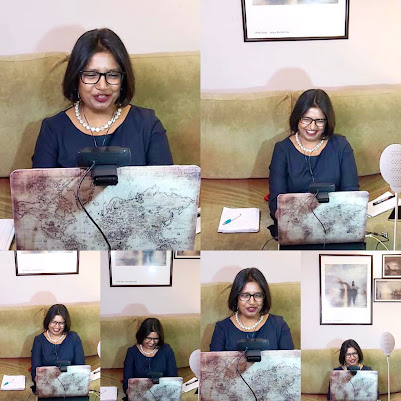
On 2 June, I did a virtual seminar on National Security Dynamics in India's Space Programme with the SpaceWatch Global's new series, Space Cafe WebTalk. I discussed how India’s approach to outer space has changed over the last decade and how it is now driven increasingly by national security concerns. I also addressed a range of other significant topics, including India’s controversial ASAT test, my thoughts on space collaboration with other nations, and the growth of private space industry in India, including ISRO’s support of it.


The talk was hosted by Torsten Kriening, co-publisher of SpaceWatch.Global and COO of ThorGroup GmbH. The Space Café WebTalks series is SpaceWatch.Global’s innovative webinar platform featuring global space experts.

For the video link to my talk, click here.


Type rest of the post here

Thursday, April 23, 2020

My Perspective On US Space Resources Executive Order: Raji Rajagopalan On The EO’s First Mover Advantage - SpaceWatch Global, April 15, 2020

Recently, I did a Q&A with the SpaceWatch Global on the US Space Resources Executive Order.

On 6 April 2020, US President Donald J. Trump signed an Executive Order (EO) on Encouraging International Support for the Recovery and Use of Space Resources. This order addresses US policy regarding the recovery and use of resources in outer space, including the Moon and other celestial bodies. Over the next few weeks, SpaceWatch.Global will publish a range of perspectives supporting and opposing the EO from experts around the world. Today’s two expert perspectives come from Rajeswari Rajagopalan of India (below) and Professor Guoyu Wang of China.


For the full Q&A, click here.


In your opinion, what is the underlying strategic and economic rationale for President Trump’s Executive Order?

The possible underlying economic and strategic rationale is to gain the first mover advantage. While the US and other western space players talk about space mining and resource extraction, China has been making progress. Whether the resource is being extracted for bringing it back to Earth or for making the Moon as the base for more ambitious plans to go to Mars, the technological benefits through spinoffs from such activities are significant. The US clearly does not want to let China gain any unilateral advantage.

The Executive Order explicitly rejects the 1979 Moon Agreement. How do you think this will be received by other countries, particularly other major space powers?

Rejection of the 1979 Moon Agreement is not a surprise because very few countries have signed and ratified it. What is surprising in the Executive Order is the explicit rejection of the idea of outer space as a global commons. Even though the suspicion was that this was how the United States (and others) viewed it, openly saying so in the EO is unusual. For that matter, even other spacefaring powers have had similar attitudes towards space because if space is truly a ‘global commons’, it would prevent other states also from activities such as resource mining in space. And this is possibly the reason why all the major spacefaring powers including the US, Russia, China, Japan and many in Europe have not signed the Moon Treaty. India is among the handful of space powers that is a signatory to it although it has not ratified it.

Similarly, the Executive Order explicitly rejects the view that space is a Global Commons. What, in your opinion, is the policy rationale behind this claim and, again, how do you think this will be received by other countries?

It is correct that this is not the first US administration to hold this view. But equally, other countries also hold such views, though they have not been as explicit about it. Trump’s action, however, might be indicator that competition for resources in space is likely to accelerate because others countries are likely to see this as reason to speed up their programs.

In your view, how likely will this Executive Order “encourage international support for the public and private recovery and use of resources in outer space…?”

Trump’s approach on setting up a base camp on the Moon has already seen many countries supporting it. I would assume these players including the UAE, Luxembourg and Canada, Australia, would find a way of supporting this idea as well.

Hypothetically assuming that this Executive Order leads to international support, will it make the prospect of commercial space resource extraction closer to reality?

It might lead to international collaboration. But I wrote an Op-Ed where I raised some of the complications of this. For example, how would national courts arbitrate any disputes unless these are subject to national sovereignty? If this is beyond national courts, how can disputes between parties engaging in such activities be resolved? Unless these legal issues are resolved, technical advances cannot by itself ensure resource extraction from space.

Monday, December 30, 2019

#SpaceWatchGL Op’ed: My 2019 in a review – Great Power Politics and Global Governance - SpaceWatch Global, 30 December 2019

I contributed an OpEd to SpaceWatch Global - My 2019 in a review – Great Power Politics and Global Governance, where I focused on two major developments - the Indian ASAT test and the end of the INF Treaty. SpaceWatch.Global had reached out to its staff and contributors to review 2019 and provide an outlook into 2020.

This has been an exciting year for me in a number of ways but also an increasingly worrying one, especially when we consider the growing threats to peace and the difficulties in getting the world’s nations to deal with them cooperatively.
Developments in the space domain and in the broader strategic realm have kept me engaged through the year. The latter provided the setting, in many ways, for many of the developments in the former, but has also been important by itself.

For the full OpEd, click here.


The developments in the broader strategic setting essentially refers to developments in the Indo-Pacific region, especially politics between the US, China, Japan and India. The region is also home to some of the fastest growing economies, which has translated to acquisition of major hard power capabilities. Competition with China has continued to tick upwards. Sino-Indian competition, in particular, is picking up. Two rounds of informal summits have not been helpful in mitigating the competition and tension in the relationship. China’s growing influence and penetration in southern Asia and Indian Ocean has led to a pushback, including the quadrilateral (Quad) arrangement, which gained further traction in 2019. Bilateral relations — such as the India-Japan, India-Australia, and India-US — and trilaterals including the India-US-Japan have become stronger for the same reason.

But one of my main focus has been on Sino-Indian competition, which is picking up, including in outer space.
The Indian anti-satellite (ASAT) in March 2019 was one consequence, a clear deterrence signal to China, which had already tested its ASAT a decade earlier. The test did raise some concern about debris in outer space. On the flip side, there were fears in India that it would yet again sit on the fence and miss an opportunity to develop a critical defense technology, as it had done in the nuclear arena. The debate on an Indian ASAT had become loud after the first successful Chinese ASAT test in January 2007. There has been consensus among all the different Indian stakeholders – the civilian, scientific and military bureaucracies – on the need to demonstrate India’s capability.

India’s newly-acquired capability has raised many questions but Prime Minister Modi argued that the test was a “defensive” move to protect India’s own space assets. Like India, most countries use space for a number of civilian applications including in areas like agriculture, disaster management, weather forecasting and communication, and there is a strong global interest to preserve outer space as a public good. Now that India has acquired an ASAT capability, New Delhi must take earnest efforts at preventing trends towards space weaponisation.

Another important issue has been the end of the INF Treaty and what it means for global security. The treaty led Washington and Moscow to destroy a total of 2,692 short-, medium-, and intermediate-range missiles by 1991. The treaty was seen as particularly important as it is the only nuclear arms control measure that abolished an entire class of weapons. Important questions have been raised as to whether the end of the INF would have strategic implications in the Indo-Pacific. Many in the US Congress as well as arms control advocates have lamented that walking out of a treaty without an alternative one in place as a recipe for an arms race.

Now that the treaty has ended, Russia could possibly build develop a series of INF-category missiles but the real concerns have been about China. Both the Obama and Trump administrations had accused Russia of violating its INF commitments, one of the reasons for the US to end the treaty. In addition to the Russian breaches, the Trump Administration was particularly worried about the Chinese inventory of around 2,000-odd ballistic and cruise missiles, a significant majority of which would be in violation of the INF if China was a party to the treaty. But now that the shackles of the INF are gone, Beijing argues that Washington could deploy conventional ground-launched missiles in East Asia that could possibly tilt the military balance in the region. This could of course legitimize all of the missiles that China has already deployed, which are threatening to its neighbours as well as the US. There has been talk about a possible multilateral arrangement as a successor to the INF but China has remained categorically opposed to such ideas.

Unfortunately, global governance mechanisms are not keeping up with the increasing threats that international peace and stability are facing. The failure was most evident at the 2018-2019 United Nations Group of Governmental Experts (GGE)
on PAROS (Prevention of Arms Race in Outer Space). The failure in developing consensus among great powers has been an issue for more than two decades now. The state of the play within the Conference on Disarmament (CD) is illustrative of this paralysed nature of inter-state relations, especially among the great powers. I was associated with the UN GGE on PAROS as a Technical Advisor to the Group, which deliberated on PAROS over two two-week long sessions but at the end, the divisions within the Group was so stark that it could not agree upon a commonly-agreed upon text to be released as a consensus report.

As the year ends, therefore, it is clear that there is a lot of work to be done if we have to maintain a stable international order. But there is also growing worry that we are running out of time.

2020 - A challenging year yet a satisfying year, professionally

2020 has remained a challenging year for the world around and I was no exception.  Personally, it was a trying year with a lot of dislocatio...